Deep Dives
Claude for Financial Advisors: Audit the Evidence Chain
Financial AI needs more than human approval: preserve source authority, calculation lineage, action boundaries, review context, and replayable evidence.
Sep 15, 2026 · 10 min readIndependent reporting on AI, developer tools and the systems behind them.
Financial AI needs more than human approval: preserve source authority, calculation lineage, action boundaries, review context, and replayable evidence.
Sep 15, 2026 · 10 min readEncoder-prefill-decode disaggregation can reduce multimodal time to first token and increase same-SLO throughput, but only when vision encoding is a large enough share of request time. Teams should trace each serving stage, benchmark a workload matrix, optimize media preprocessing and caching, and promote only the traffic buckets that clear a reversible latency and cost gate.
OpenAI's GPT-Image-2.5 launch adds Flare for fast everyday generation and Sunburst for precision editing. Teams should migrate with a versioned edit-drift suite that measures protected-region change, instruction success, identity and layout retention, latency, and realized cost instead of trusting a few attractive samples.
A deployment guide to EVIE and the new index-cost tradeoffs in visual document retrieval.
Four architecture lessons from Claude’s machine-checked formalization of Fermat’s Last Theorem.
A practical four-test framework for tracking whether Hugging Face remains open, multi-provider, and hardware-neutral under NVIDIA.
AI coding agents need explicit context, permission, logging, and review boundaries as they gain access to real engineering workflows.
Claude's new watermark can signal model processing, but it cannot prove authorship or rule out AI use when absent.
OpenAI now offers an official ChatGPT desktop preview for Linux. Here is the supported distro matrix, install path, security model, and what is still missing.
Google ADK now lets teams regression-test live voice agents with synthetic audio, tool assertions, and multi-turn rubrics.
A decision guide for choosing LFM2.5 QAD or DSpark based on memory, quality, runtime support, and decode latency.
A practical audit guide for GitHub Copilot’s August 26 default model availability change and September model retirements.
Atlaso is a cross-tool AI memory layer from Atlaso Labs that installs into Claude Code, Cursor, Codex, Claude Desktop, OpenCode and Antigravity via a single shell command, capturing decisions after each turn and injecting the top five relevant memories before the next one. Its published four-judge study on LongMemEval-S (n=500, shared Qwen 3.5-9B reader) shows Atlaso beating mem0 by 9.8 to 14.8 percentage points, and also documents an 11.5-point loss to mem0 on the adversarial LoCoMo subset plus a failure to reproduce mem0's headline 93.4 percent figure. The shipped product lags the research: supersede logic is not triggered automatically, injected memories are invisible from the terminal, and there is no team memory or self-hosting. Free covers one device and one tool; Pro is 10 dollars a month and Build is 25.
Prelint is a GitHub and GitLab app that reviews every pull request against a team's product specs, ADRs, and prior decisions rather than against the code itself, targeting what it calls product drift: technically correct code that quietly contradicts decisions the team already made. It launched on Product Hunt on July 29, 2026, taking #1 Product of the Day and #1 Product of the Week with 676 points. The core architecture is a decision ledger that weighs the authority of each decision and supersedes rather than deletes entries, exposed to agents through a CLI and MCP server. Prelint's own research across 56,706 public pull requests found that docs context raised the reviewer flag rate from 13.3% to 36.6% at 80.8% precision. Pricing is $1 per completed review with no seats, and public repositories are free.
Google Antigravity is a VS Code fork built around autonomous agents, with a Manager View that dispatches up to five parallel agents and a built-in Chrome browser for front-end verification. Gemini is the default model, with Claude and GPT supported. Strengths are parallel-agent workflow and browser verification; weaknesses are shifting credit-based pricing, a five-agent cap, and a closed-source core. The verdict: a strong secondary tool, especially for front-end and Gemini-centric workflows.
Marin’s 535B run shows how public scaling ladders and failure logs can make frontier-model training auditable before weights exist.
SpeakoFlow is a free, MIT-licensed local-first voice assistant for Windows, macOS and Linux, built by solo developer Abhishek Barali as a fork of CJ Pais's Handy. It combines hotkey dictation, a 'Hey Flow' generative writing mode, an assistant panel with screen vision, live translation and AI cleanup. Speech-to-text always runs on-device via whisper.cpp and Parakeet; the assistant can run fully offline through a built-in llama.cpp engine, through Ollama or LM Studio, or through any OpenAI-compatible cloud provider with your own key. There is no account and no telemetry. The trade-offs are real: the binaries are not code-signed on Windows or macOS, requiring a manual quarantine-clearing step on Mac, and the project is at v1.0.1 with 126 commits, six GitHub stars and one maintainer.
Meetily is a privacy-first, open-source AI meeting assistant with 27.4K GitHub stars and an MIT license. Built on Rust and Tauri, it runs Whisper or Parakeet transcription and Ollama summarization entirely on your own device, so meeting audio never touches the cloud. It supports macOS and Windows, with flexible summary providers and a commercial PRO tier.
MTIA 300 shows why network and collective-communication bottlenecks can matter more than peak accelerator FLOPS.
Matryoshka Language Model Suites nest 500M, 1.5B, and 3B checkpoints in one training run, cutting suite-level compute while improving draft-verifier efficiency.
Cosmos 3 Edge is a broad physical-AI foundation model; specialized VLAs remain the better fit for latency-bound robot control.
Why the EU battery passport turns 2026 into a data-operations deadline for EV and industrial battery supply chains.
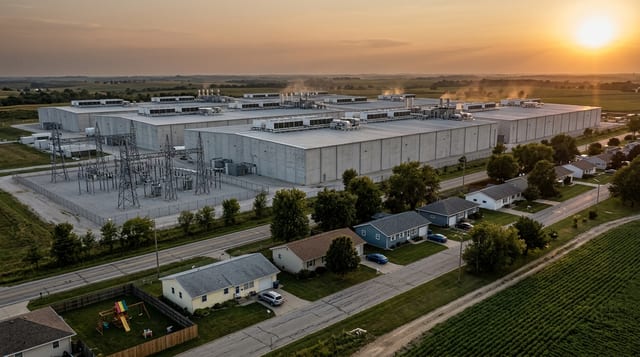
On July 14, 2026, New York Governor Kathy Hochul signed Executive Order No. 62, creating the first statewide moratorium on new hyperscale data centers by pausing discretionary environmental permits for up to a year while the state drafts a Generic Environmental Impact Statement. The pause follows a collapse in local consent: Data Center Watch recorded at least 75 projects worth roughly $130 billion blocked or delayed in Q1 2026 alone, nearly matching all of 2025, with opposition groups more than doubling across 49 states. Gallup found seven in ten Americans oppose an AI data center locally, 48% strongly. Underlying grievances are documented: data centers may reach 12% of US electricity by 2028, large sites use up to 5 million gallons of water daily, and 80% of surveyed Virginia municipalities had NDAs with developers. Maine's own moratorium died by a failed veto override in April.