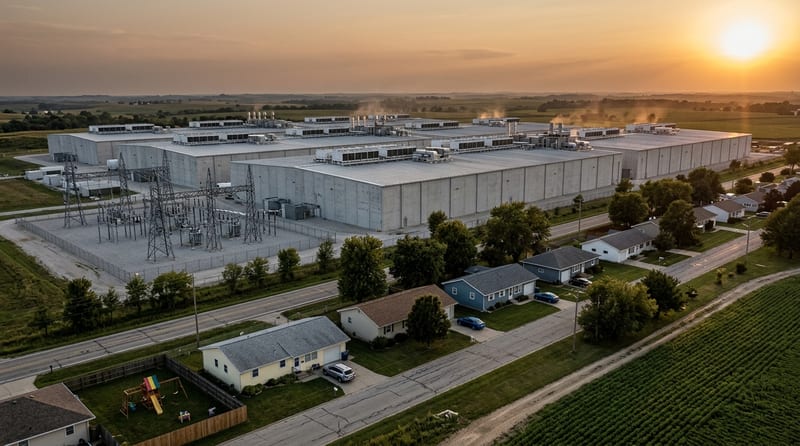
For three years the AI industry treated physical infrastructure as a solved problem. Capital was available, land was cheap, and local officials were grateful. Compute was the bottleneck; permission was a formality.
That assumption died in 2026.
On July 14, 2026, New York Governor Kathy Hochul signed Executive Order No. 62, creating the first statewide moratorium on new hyperscale data centers in the United States. The state's Department of Environmental Conservation will not issue discretionary environmental permits that were not already deemed complete — a pause of up to one year while the Department of Public Service develops a Generic Environmental Impact Statement for data centers.
The largest AI buildout in history now has a consent problem. And unlike a chip shortage, you cannot solve it with capital.
The numbers behind the pause
The scale of the reversal is easy to underestimate, so start with the money.
According to Data Center Watch, at least 75 projects worth roughly $130 billion were blocked or delayed by local opposition in the first quarter of 2026 alone — what the group calls the largest single-quarter concentration of blocked and delayed projects on record. For context, full-year 2025 totalled about $156 billion. Q1 2026 roughly matched an entire year in three months.
| Period | Projects blocked or delayed |
|---|---|
| Full-year 2025 | ~$156 billion |
| Q1 2026 alone | ~$130 billion (75+ projects) |
Data Center Watch is explicit that this is structural, not cyclical: communities have internalized a repeatable opposition playbook, and the number of active opposition groups more than doubled after Q4 2025, now spanning 49 states.
The legislative response arrived just as fast. More than 300 state data center bills were filed in the first six weeks of 2026, with statewide moratorium proposals introduced in 14 states — from both parties.
This is not a partisan issue, and that is the story
A Gallup survey conducted by Recon MR from March 2–18, 2026 (1,000 U.S. adults across all 50 states and D.C.) found that seven in ten Americans oppose construction of an AI data center in their local area. The intensity matters more than the topline:
- 48% strongly oppose
- 23% somewhat oppose
- 20% somewhat favor
- 7% strongly favor
Nearly half of the country is strongly opposed to a category of building most people could not have defined in 2023. Among opponents, environmental concerns dominate: about half cite excessive resource use, with 18% each naming water and energy specifically.
There is no coalition to peel off here. When 48% strongly oppose something, a public relations campaign is not the missing input.
Why residents are not being irrational
It is tempting for the industry to file this under NIMBYism. The underlying numbers make that hard to sustain.
Energy. A single modern AI data center can consume as much power as 100,000 homes, per the IEA — and many larger facilities now under construction are expected to use up to twenty times that. Lawrence Berkeley National Laboratory found data centers could account for up to 12% of all U.S. electricity consumption by 2028. Grid Strategies projects up to 90 GW of data center load coming online by 2030, roughly nine times New York City's peak summer demand.
Meanwhile, 2025 brought over $60 billion in utility rate increases nationwide, with Americans paying almost 10% more for electricity than in 2024. Rate hikes have complex causes, but WRI notes evidence that procuring and building energy infrastructure for data centers contributed to price increases in at least the Mid-Atlantic.
Water. Mid-sized facilities can use up to 300,000 gallons per day; large ones as much as 5 million gallons daily. By 2028, U.S. AI data centers could require up to 32 billion gallons annually — comparable to the indoor water use of roughly 360,000 households. Two-thirds of data centers built or in development since 2022 sit in water-stressed areas.
Air. Diesel backup generators emit 200 to 600 times more nitrogen oxides than natural gas plants. One Virginia analysis estimated that even limited backup generator use could already be associated with nearly $300 million in annual public health costs and 14,000 asthma-related health impacts across multiple states. In Memphis, more than 30 natural gas turbines intended for daily operation at xAI's Colossus site drew a Clean Air Act notice of intent to sue from the NAACP and local residents.
Noise. Smaller diesel generators reach roughly 85 decibels; larger industrial units approach 100 — a jackhammer, running for hours. Residents in Loudoun County, Virginia reported sleep disruption and headaches.
Jobs. This is where the civic bargain gets thin. A review of more than 1,200 U.S. data centers found that even the largest employ fewer than 150 permanent workers — sometimes as few as 25. Construction jobs are real and well paid, and they end.
The transparency problem is the ethics problem
Here is the finding that should trouble anyone who believes local consent is legitimate: a review of 31 Virginia municipalities with existing or proposed data centers found 25 of them — 80% — had non-disclosure agreements in place with developers.
Communities were asked to approve projects whose power draw, water demand, and site plans their own officials were contractually forbidden to discuss. Federal permitting policy moved the other way, shortening environmental review timelines for large data center projects.
That is not a communications failure. It is a governance design that treats public input as a risk to be managed, and it explains the ferocity of the backlash far better than any account of irrational neighbors. When people are denied information, they reasonably assume the worst — and they organize.
Maine came within one vote
The industry got a warning it did not read. Maine's legislature passed LD 307, which would have banned data centers larger than 20 megawatts until November 2027. Governor Janet Mills vetoed it on April 24, 2026, saying a moratorium was "appropriate given the impacts of massive data centers in other states on the environment and on electricity rates" — but objecting that the final bill carved out no exemption for a proposed project in the Town of Jay, on the site of a paper mill that closed in 2023.
On April 29, the House voted 72–65 to override. A clear majority, and short of the two-thirds required. The veto stood, and Maine came within a handful of votes of the first statewide data center ban in U.S. history.
Bill sponsor Rep. Melanie Sachs said Mills had traded protection for 1.4 million residents for a single project that "without proof, promised 100 jobs," adding that her committee's requests for evidence on the project's water and energy use went unanswered:
This is not about being anti-development. It is about being pro-accountability.
The coda arrived on June 18, 2026, when the developer backed out and the Jay project was put on hold indefinitely — the carve-out that killed a statewide moratorium outliving the moratorium itself by seven weeks.
Wisconsin voters in Port Washington approved the country's first ballot referendum limiting data center construction on April 8, 2026. Three months later, New York did what Maine's legislature could not.
What New York is actually building
The most interesting thing about EO 62 is that it is not a prohibition. It is a demand for terms.
Alongside the permit pause, Hochul directed:
- The Energize NY proceeding, requiring data centers to either pay more for energy or supply their own
- A Community Investment Framework from Empire State Development within 60 days, giving localities negotiating guidance on infrastructure, child care investment, prevailing wage, local hiring, and apprenticeships
- Consideration of a Grid Acceleration Fund, including an insurance pool against speculative large loads
- Legislation to repeal sales tax exemptions for massive data centers
Once the standards are finalized, the moratorium lifts. Read plainly, that is a state saying it will host the AI buildout — but as a counterparty rather than a supplicant.
The Bottom Line
The compute buildout was underwritten by an assumption that has now failed twice: that communities would accept industrial-scale infrastructure in exchange for tax revenue and a few dozen permanent jobs, negotiated under NDA.
$130 billion in a single quarter is the price of that assumption. Seven in ten Americans, with 48% strongly opposed, is the political ceiling it created. New York's answer — pause, set standards, make developers fund the grid they strain, then proceed — is the first serious attempt at a framework rather than a fight.
Whether the rest of the industry treats that as a model or an obstacle will determine how much of the projected buildout ever gets poured. The technical bottleneck was always solvable with money. This one requires something the sector has been notably bad at: showing up honestly, before the zoning hearing.