On August 10, 2026, Anthropic published guidance explaining how supported Claude models will mark generated content. Models launched in the EU on or after August 2 add an imperceptible watermark to generated text at the model level, while supported files can receive signed provenance metadata. The marking applies worldwide, not only in Europe.
The important part is what Anthropic does not claim. A detected mark is not proof that Claude authored a document, and a missing mark is not proof that AI was absent. Claude may only have proofread or translated human writing; editing can weaken the signal; and Anthropic has not yet released its detection mechanism.
For developers, publishers, schools, and employers, the right mental model is provenance signal, not authorship verdict.
Claude uses two different kinds of marking
Anthropic's official marking guidance describes two complementary systems. They solve related but different problems.
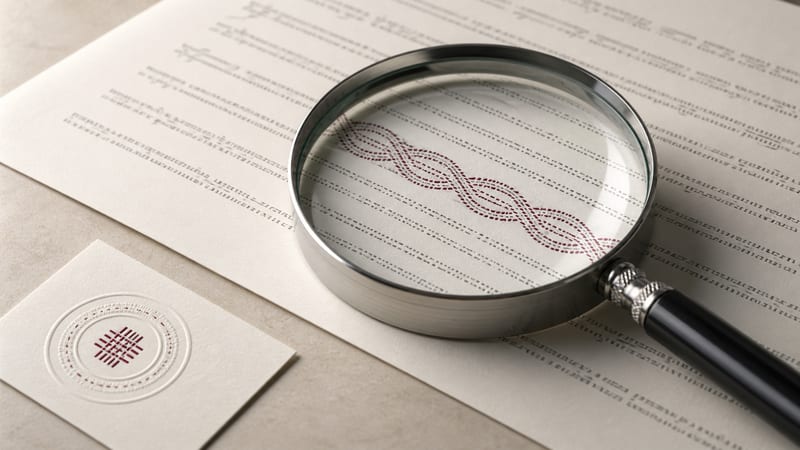
Text receives an embedded watermark. A supported model weaves an imperceptible pattern into generated text. Anthropic says the pattern does not change the meaning, quality, or readability of the response. Because it is part of the text rather than ordinary file metadata, it travels when someone copies and pastes the words and may survive some editing.
Anthropic has not disclosed the technical construction of that pattern. There is no basis yet for claiming it uses zero-width Unicode characters, a specific token-selection algorithm, or any other particular implementation. The company says detection details will arrive in future technical documentation.
Files can receive signed provenance metadata. When Claude produces a supported file type—including .svg, .png, or .jpg—it can attach a signed record following the C2PA Content Credentials standard. That record can show that Claude processed the asset and whether the signed provenance data still validates against it.
These mechanisms have different durability. Text marking is designed to remain with copied words, although it can be weakened by rewriting. File provenance is cryptographically verifiable, but ordinary operations such as re-saving, conversion, or taking a screenshot can strip the metadata.
Where the Claude watermark applies
The rollout is broader than the Claude chat interface. Anthropic says supported models mark output across:
- Claude Platform, including API output
- Claude, Claude Code, Claude Cowork, and Claude Tag
- Supported-model access through AWS, Google Cloud, and Microsoft Foundry
- Every region where that supported model is offered
Text watermarking is applied at the model level, so changing the product surface does not by itself remove it. Signed file metadata is less universal because each platform and file-processing path must support it.
The date boundary also matters. New Claude models launched in the EU on or after August 2, 2026 support marking from launch. Anthropic says it is working to add marking to earlier models. The European Commission's implementation FAQ gives systems already on the market a transition period until December 2, 2026.
That means a team cannot assume every Claude output is marked today merely because the policy exists. Model age, platform support, content length, and subsequent editing all affect what can be detected.
What a detected mark actually tells you
The most valuable sentence in Anthropic's guidance is also the most cautious: finding a supported mark indicates that the content may have been processed by Claude. That is narrower than “Claude wrote this.”
| Signal | Reasonable interpretation | Unsafe conclusion |
|---|---|---|
| Text watermark detected | A supported Claude model may have processed the passage | Claude originated every idea and sentence |
| C2PA provenance validates | The signed record is bound to this file and has not been invalidated | The content is true, accurate, or fully AI-generated |
| No mark detected | No supported Claude signal was found | No AI system touched the content |
| Mark survives editing | Some Claude-origin signal remains after changes | The final editor made no meaningful contribution |
This distinction matters in real workflows. A journalist could ask Claude to tighten a human-written paragraph. A developer could use Claude to reformat documentation. A researcher could translate an original draft. The resulting text may carry a Claude mark even though the underlying reporting, code, or ideas came from a person.
Conversely, a Claude-written passage may lose a detectable signal after heavy paraphrasing, translation, mixing with other prose, or aggressive shortening. Very short passages may never contain enough signal for reliable detection.
A watermark detector should therefore not be treated like a plagiarism match or a cryptographic authorship certificate. It answers a smaller question: is there a supported Claude-origin signal in this artifact?
Why Anthropic is doing this now
The timing follows the EU AI Act's transparency rules. Article 50(2) requires providers of systems generating synthetic text, audio, images, or video to make outputs machine-readable and detectable as artificially generated or manipulated, as far as technically feasible.
The European Commission's Transparency Code of Practice is voluntary, but Article 50 itself is a legal obligation. The rules became applicable on August 2, 2026. Anthropic signed the code and is using embedded text watermarks plus signed file provenance to implement its commitments.
The law also shows why “watermark” and “visible disclosure” should not be collapsed into one concept. Providers mark model output so machines can detect it. Deployers may have separate duties to disclose deepfakes or AI-generated public-interest text, subject to the law's exceptions—including human review and editorial responsibility for certain text publications. A hidden mark is infrastructure; it is not automatically the user-facing label a publisher may need.
What developers should change
Teams integrating Claude should treat Anthropic's marks as one layer in a wider audit trail.
Record the model and surface. Store the exact Claude model identifier, provider route, timestamp, and request ID where permitted. Do not rely on a future watermark detector as your only provenance record.
Preserve the original artifact. If provenance matters, retain the first generated file before conversion or optimization. A screenshot or export may remove signed metadata.
Separate assistance from authorship. Product policies should distinguish generation, editing, translation, summarization, and formatting. A binary “AI-written” field throws away useful context.
Avoid disciplinary automation. Do not reject a student, employee, applicant, or author solely because a Claude mark is reported. Anthropic explicitly warns that detection is not conclusive proof of authorship.
Do not promise detection yet. Anthropic says user and third-party detection support is coming, but it has not published the mechanism or technical interface. Product roadmaps should wait for documented capabilities.
Keep visible disclosure separate. If your product publishes material covered by Article 50, assess the deployer-facing labelling rules independently. A machine-readable mark may not satisfy every disclosure obligation.
Limitations and unresolved questions
Anthropic has not published false-positive rates, false-negative rates, minimum reliable passage length, robustness benchmarks, or a public detector. Without those details, independent researchers and customers cannot yet evaluate the watermark's practical reliability.
The rollout language also leaves implementation questions. Earlier Claude models are still being updated, and signed provenance metadata depends on platform and file-type support. The company says it will update its guidance as technical documentation becomes available.
Finally, neither watermarking nor C2PA establishes factual truth. C2PA verifies signed provenance claims and whether they remain bound to an asset; it does not certify that the underlying content is accurate. Provenance can improve accountability without replacing verification.
The Bottom Line
Claude's hidden text watermark is meaningful because it moves AI provenance into the model output itself and follows copied text across product surfaces. But it is deliberately a signal, not a verdict.
Developers should preserve their own audit logs, publishers should keep visible disclosure separate, and institutions should never use detection alone to decide who authored a piece of writing. Until Anthropic releases the detector and reliability data, any stronger claim runs ahead of the evidence.