MTIA 300: Why Meta Put the Network Inside Its AI Chip
On August 24, 2026, Meta published the production details behind MTIA 300, its first in-house accelerator optimized for training ranking and recommendation models. The important change is not a bigger FLOPS number. Meta moved twelve RDMA network interfaces into the chip package and added dedicated engines that execute collective communication without borrowing the compute cores needed by the model.
That design matters because large recommendation systems often wait on data movement rather than matrix multiplication. Meta reports that, on one 150-billion-parameter production model, MTIA 300 cut total communication time to roughly one quarter of an equivalent GPU cluster's result. The useful lesson for infrastructure teams is broader: when communication dominates a workload, buying more arithmetic can leave the real bottleneck untouched.
Reader value: MTIA 300 offers a practical way to decide whether an AI workload needs more compute, more memory, or a network-first accelerator architecture.
MTIA 300 Treats Communication as Part of the Chip
Recommendation models are structurally awkward for conventional accelerators. Meta says embedding tables can contain more than 99% of their parameters, and training them across hundreds of devices creates constant AllReduce, AllToAll, and AllGather traffic. On a general-purpose GPU system, communication kernels and training kernels may compete for the same streaming multiprocessors.
Meta's MTIA 300 architecture attacks that conflict at three levels:
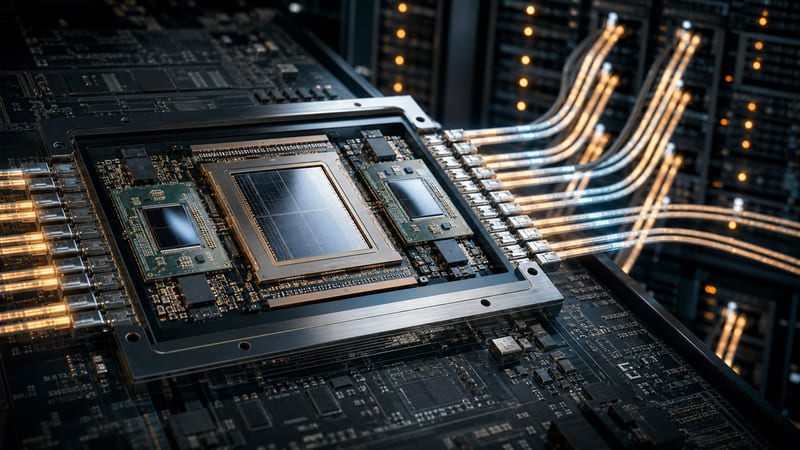
- On-package networking. Two network chiplets contain twelve custom 800 Gbps RDMA NICs in total, exposing 1.2 TB/s of aggregate I/O without crossing a host PCIe path.
- Dedicated message engines. Sixteen message engines schedule transfers and reductions separately from the 12-by-6 grid of processing elements.
- Near-memory reduction. The near-memory blocks collectively provide more than 2.8 TB/s of reduction throughput, according to Meta, so common collective operations do not have to occupy the compute grid.
This is not merely faster networking attached to a familiar accelerator. The network, memory hierarchy, communication runtime, and compute array were designed as one system.
HCCL Is the Other Half of the Architecture
Hardware offload is useful only when the software can express work predictably. Meta co-designed HCCL, its collective communication library, with MTIA 300. Rather than asking the host to drive each stage while a job is running, HCCL compiles a collective into work-queue subgraphs with explicit dependencies and dispatches them to the message engines.
The HCCL paper describes topology-aware selection across MTIA 300's asymmetric network. Within a rack, the system prioritizes the high-bandwidth scale-up path. Across racks, it tries to minimize traffic on the narrower scale-out path. HCCL also integrates with PyTorch's c10d and torchcomms interfaces, while operations traced through torch.compile can be combined with the compute graph.
Meta reports up to 940 GB/s for intra-rack collectives and less than 0.5% degradation to concurrent compute throughput. Its engineering post contrasts that with more than 20% degradation on the GPU setup it tested. Those are impressive numbers, but they are workload- and topology-specific vendor measurements—not a universal GPU comparison.
The 3.9x Result Needs the Right Denominator
The headline production result comes from a 150-billion-parameter recommendation model running on 40 accelerators. Meta says MTIA 300's total communication time was 3.9 times faster than the equivalent GPU cluster. It also lists 216 GB of HBM3E per accelerator and a one-to-one CPU-to-accelerator ratio, both of which can change batch size and optimizer placement.
The result is evidence that the architecture works for Meta's target workload. It is not evidence that MTIA 300 trains a general-purpose language model 3.9 times faster, nor that it delivers 3.9 times better end-to-end cost. Meta has not published an acquisition price, power curve, full training-time comparison, or reproducible public benchmark for this production model.
That distinction is essential. Communication time is one component of total step time. A large improvement there can be transformative when collectives dominate, but modest when the workload remains compute-bound.
A Decision Framework for Infrastructure Teams
MTIA 300 is internal hardware, so most developers cannot choose it directly. They can still apply its design logic to accelerator and cluster decisions.
Measure the collective duty cycle. Profile how much step time is spent in
AllReduce,AllToAll, andAllGather, including the portion that cannot overlap with compute.Separate scale-up from scale-out. Intra-rack bandwidth, cross-rack bandwidth, message size, and tail latency create different bottlenecks. One aggregate network number hides them.
Test compute-communication overlap. Peak bandwidth means little if collectives consume the same execution resources as model kernels. Measure model throughput while both run together.
Use the real parallelism plan. Recommendation training, mixture-of-experts routing, tensor parallelism, and data parallelism produce different traffic patterns. Benchmark the topology you intend to deploy.
Include software portability. A specialized accelerator can win on its target model while losing engineering time to compiler gaps, missing kernels, debugging friction, or unsupported operators.
The broader custom-silicon movement supports this workload-first approach. Google's TPU 8i design, for example, also emphasizes memory capacity, KV-cache locality, interconnect bandwidth, and latency for agentic inference rather than relying on peak compute alone. The architectures differ, but the direction is consistent: data movement is becoming a first-class design constraint.
MetaRoCE Extends the Same Idea Beyond the Package
Meta released the MTIA 300 details alongside MetaRoCE, a proposed RDMA transport for large AI clusters. The pairing is instructive. MTIA 300 reduces contention between compute and communication inside the accelerator system; MetaRoCE tries to make scale-out Ethernet tolerate reordering, multipath traffic, congestion, and packet loss more gracefully.
Meta says it plans to contribute the specification, a software reference implementation, and a compliance framework through the Open Compute Project in October 2026. Until those artifacts arrive, the transport is a roadmap rather than something outside teams can independently validate.
Taken together, the releases show a coherent position: the network should understand AI traffic at the endpoint, while accelerators should stop treating communication as an external tax.
Limitations and Open Questions
MTIA 300's published evidence has clear boundaries:
- The strongest benchmark comes from Meta's private recommendation workload and an unspecified equivalent GPU-cluster configuration.
- The 3.9x figure covers communication time, not complete model training time or cost.
- Public data does not yet establish power efficiency, reliability, utilization across diverse models, or developer productivity.
- HCCL is tightly co-designed with MTIA hardware, so its portability to other accelerators is not demonstrated.
- MetaRoCE's promised open specification and compliance suite were not available at publication time.
These limits do not erase the architectural result. They define what still needs independent measurement.
The Bottom Line
MTIA 300 is compelling because it spends silicon on waiting, not just computing. By integrating NICs, offloading collectives, and compiling communication alongside model execution, Meta attacks the part of distributed training that peak-FLOPS comparisons routinely ignore.
For infrastructure teams, the actionable takeaway is simple: profile data movement before selecting an accelerator. If communication is the bottleneck, the best chip may be the one that keeps its compute cores out of the networking business.