Model Hardware Standard: A Safer Contract for AI Agents
Anthropic opened a research preview of the Model Hardware Standard (MHS) on August 27, 2026. It is a proposed shared interface through which AI agents can operate programmable physical equipment in scientific research and advanced manufacturing. That sounds like a natural extension of software-agent tooling. It is not.
The important change is not that a model can issue commands to a robot. Hardware vendors have exposed SDKs for years. MHS makes a different promise: it tries to put a standard contract between an agent's high-level intent, a device's state, and the actions that may safely be taken. For teams building lab automation, robotics, or factory workflows, that contract—not chat-driven control—is the real decision surface.
Reader value: Treat MHS as a design review for physical-agent integrations: decide what the model may propose, what the device layer may execute, and what evidence is required before either can advance a run.
What changed, and what did not
Anthropic's research-preview announcement describes MHS as a shared specification for AI agents to operate physical devices. The company is starting with scientific labs and advanced manufacturers, rather than positioning it as a universal robot-control protocol. That scope is sensible: these environments already have programmable instruments, repeatable procedures, and operators who understand failure modes.
MHS is not a magic compatibility layer for every machine. Anthropic explicitly says it does not yet work with equipment that lacks a programming interface. Nor is it a replacement for expert supervision: the company notes that model spatial and physical reasoning remain limited. Those are not footnotes. They are the boundary conditions that should shape every rollout.
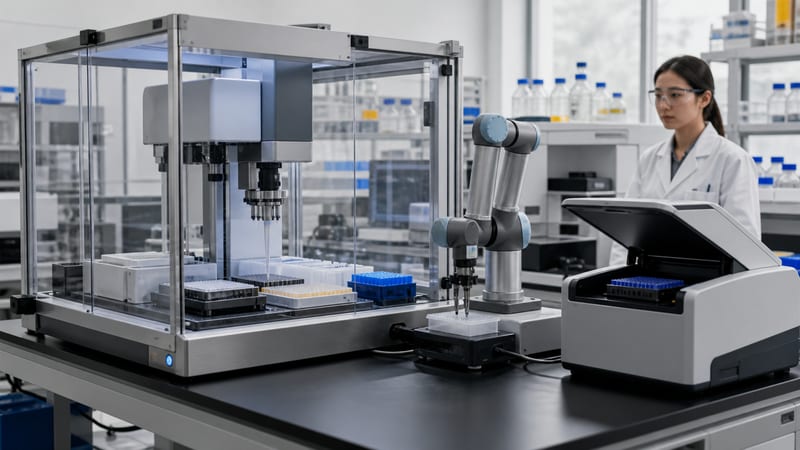
The strongest early example is a Genentech proof of concept that coordinated a liquid handler, a robotic arm, and a plate reader for a BCA protein assay. The interesting detail is not the use of natural language. It is the closed loop: the system set a liquid-transfer parameter, observed plate-reader results, compared those results with an expert control, and iterated. That is closer to experimental orchestration than to a chatbot pressing buttons.
The interface is only one of three contracts
Teams will be tempted to ask a simple question: Does our device support MHS? The better question is whether the integration satisfies three separate contracts.
| Contract | What it must define | Failure if it is vague |
|---|---|---|
| Capability | Which commands exist, their units, ranges, prerequisites, and effects | An agent can request a valid-looking but physically unsafe action |
| State | Sensor readings, calibration status, alarms, uncertainty, and freshness | The agent acts on stale or incomplete observations |
| Authority | Who may propose, approve, execute, pause, and recover | A convenience layer quietly becomes an uncontrolled actuator |
The first contract is familiar to robotics engineers. Hugging Face's LeRobot hardware-integration guide makes the point clearly: a device needs a communication interface, a programmatic way to read sensors and send commands, and explicit observation and action features. MHS can make that interface more uniform; it cannot invent missing telemetry or reliable device semantics.
The second contract is where agent demos often become misleading. A model seeing “temperature: 22” does not know whether the reading is one millisecond old, whether the probe is calibrated, whether a safety interlock has tripped, or whether an operator changed the setup. Device state needs provenance, timestamps, and an explicit unknown state. If an integration cannot distinguish safe, unsafe, and not known, it is not ready for autonomous execution.
The third contract is the decisive one. An LLM should normally be a planner and diagnoser, not the final source of authority for irreversible motion, dispensing, heating, or exposure. A safe architecture lets the model propose an intent, checks that intent against a deterministic policy layer, executes only allowed operations, and sends an auditable result back to the model.
A practical MHS rollout pattern
Start with an execution boundary that is deliberately boring. The agent can request a named operation with typed parameters; a device adapter verifies it; an interlock service decides whether to execute. Do not send free-form model text directly to a motor, pump, laser, or furnace.
agent plan
  -> typed operation request
  -> capability and range validation
  -> interlock / approval policy
  -> device adapter
  -> command acknowledgement + fresh telemetry
  -> immutable run record
For an early deployment, use four operating modes:
- Observe-only: the model reads state, summarizes anomalies, and recommends next steps. No actuation.
- Shadow execution: the system produces the operation sequence that an expert would run, then compares it with the actual run.
- Bounded execution: the agent may execute a small, reversible set of operations within predefined ranges.
- Supervised closed loop: the system can iterate based on measurements, but a human owns transitions into higher-risk phases.
The order matters. It turns MHS from an all-or-nothing automation bet into a set of testable claims. Before advancing a mode, require evidence that the adapter rejects invalid units and out-of-range values, that stale sensor data fails closed, that a run can be paused without ambiguous device state, and that an operator can reconstruct who authorized every action.
The hidden bottleneck is device truth
A common mistake is to frame physical AI as a reasoning problem. In practice, the bottleneck is often a device-truth problem. A model may produce a sensible protocol, but the hardware stack still needs to answer: Is the instrument connected? Is it calibrated? Is the sample in the expected location? Did the commanded action complete? Did it complete within tolerance?
That is why the Genentech example matters. It used measurements from the plate reader to evaluate a transfer, rather than treating the command itself as proof of success. The distinction is crucial: a device API can acknowledge a command even when the physical outcome is wrong.
Design each MHS adapter around observed outcomes, not merely command logs. For every operation, define the expected physical evidence, the acceptance range, and the response when evidence is absent. A dispense action may require a mass, pressure trace, camera check, or downstream assay result. A robotic move may require position feedback and collision-state confirmation. The correct evidence depends on the device, which is exactly why a shared interface must not flatten safety semantics into a generic success: true.
Security belongs in the control plane
The more capable the agent, the more tempting it is to give it broad access to drivers, scripts, and model packages. Resist that temptation. LeRobot's security guidance recommends pinned revisions for remote code and warns against treating arbitrary model artifacts as trusted. That advice becomes more important when downstream software reaches real equipment.
A minimum control plane should include:
- Signed, versioned adapters: know exactly which driver and schema executed a run.
- Least-privilege capability scopes: an agent that can read a camera does not automatically get permission to move an arm.
- Deterministic policy checks: range, rate, sequence, and environmental constraints must be evaluated outside the model.
- Human break-glass controls: a local, documented stop path must work even if the agent service is unavailable.
- Replayable evidence: preserve requests, approvals, device state, acknowledgements, and outcome measurements.
This is not bureaucracy. It is the difference between debugging a failed experiment and guessing whether a model, adapter, operator, or instrument made the wrong move.
Where MHS is likely to help first
MHS-style interfaces should be most valuable where equipment is programmable, procedures are structured, and results arrive quickly enough to steer the next step. Lab automation is an obvious fit. So are test rigs, imaging setups, inspection cells, and manufacturing workflows with well-defined guardrails.
The poor fits are equally important: uninstrumented equipment, workflows with missing calibration discipline, tasks whose safety case depends on tacit expert judgment, and environments where a bad action cannot be recovered or independently verified. In those settings, MHS may still help with observation and planning, but it should not be treated as permission for unattended actuation.
Limitations to keep front of mind
MHS is a research preview, not a mature interoperability guarantee. Anthropic has not yet open-sourced the standard, so teams cannot independently assess its complete schema, conformance requirements, or governance process. Early partner examples are promising evidence of direction, not proof that integration effort or safety properties generalize across devices.
There is also a governance question. A useful hardware standard needs more than an API. It needs clear versioning, conformance tests, capability semantics, incident reporting, and a way for vendors and operators—not only model providers—to shape its evolution. Without that, “standard” risks becoming a thin adapter around one vendor's orchestration stack.
The Bottom Line
Model Hardware Standard is worth watching because it reframes physical AI around an interface contract, not a model demo. The immediate opportunity is not letting an agent do everything; it is making device capabilities, safety checks, and observed outcomes explicit enough that teams can automate narrow workflows with confidence.
If you are evaluating MHS, begin with a single instrument, a typed and bounded operation set, independent outcome checks, and a human-owned stop path. Earn the next degree of autonomy with evidence.