For most of its life, Mistral AI has been the European answer to OpenAI: lean open-weight models, a chat app, and an API. At its AI Now Summit on May 28, 2026, the company made a different argument entirely. The future it is betting on isn't a better chatbot — it's AI that designs aircraft, simulates car crashes, and tunes semiconductor parts. This is a deliberate pivot from consumer assistant to industrial infrastructure.
The headline: AI for industrial engineering
The centerpiece announcement is an integrated stack that combines physics models, engineering expertise, and robotics aimed at "mission-critical industrial operations." The pitch to manufacturers is specific: accelerate design, eliminate simulation bottlenecks, and optimize asset performance — while keeping full control over proprietary data, IP, and production environments.
That last clause is the whole strategy. Mistral is selling sovereignty as much as capability. For European aerospace, automotive, and chip firms wary of routing sensitive designs through American clouds, "you keep your data" is a feature competitors struggle to match credibly.
Three names that matter: Airbus, BMW, ASML
What makes this more than a vision deck is the customer list.
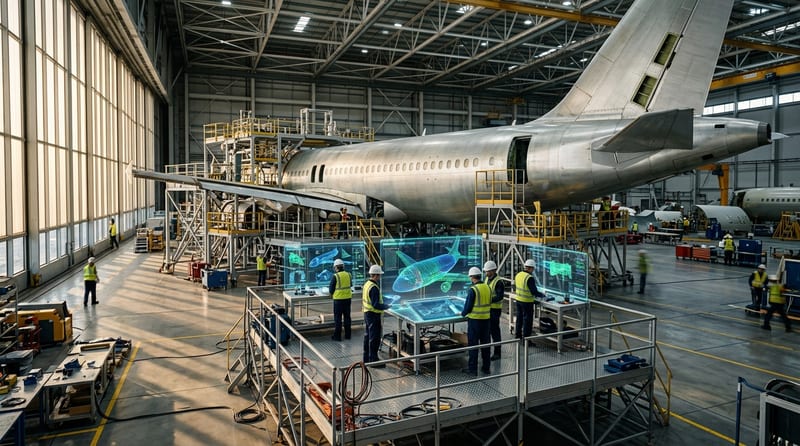
- Airbus — Mistral says it is embedding AI "at the core of the company's operations," spanning commercial aircraft, helicopters, defence, and space. The stated goals include improving flight safety and keeping critical data under Airbus's control.
- BMW Group — Mistral is a central partner on BMW's "Large Industry Model" (LIM) initiative, building multimodal reasoning models on engineering data for complex tasks such as crash simulation.
- ASML — the Dutch lithography giant has started using Mistral to optimize the design of high-performance parts, build surrogate models, and tune control loops in advanced semiconductor environments.
The common thread: these are domains where a hallucinated answer isn't an annoyance, it's a safety or yield problem. Grounding AI in "deep domain expertise, system knowledge and real-world constraints," as Mistral puts it for the ASML work, is the entire value proposition.
The Emmi acquisition is the engine
None of this works without physics. On May 22, 2026, Mistral announced its acquisition of Emmi, a physics-AI company, to bring scientific simulation capabilities in-house. Physics AI is what lets a model reason about stress, fluid dynamics, or heat instead of just text — the difference between a chatbot that describes a crash test and a model that predicts one.
Folding Emmi in gives Mistral something most frontier labs lack: a native path to surrogate models that can replace or accelerate the brutally expensive physical simulations manufacturers run today.
Vibe and the long-horizon agent
Mistral also consolidated its agent story under Vibe, now positioned as a single agent for long-running, multi-step work. It catches up across inbox and calendar, runs deep research, drafts deliverables, and orchestrates recurring processes. It also takes coding work "from request to merged change" across web, editor, and terminal — building features, fixing bugs, and shipping reviewable pull requests. Vibe runs on flagship Mistral models tuned for reasoning, tool calls, and coding.
Sovereignty, all the way down to the metal
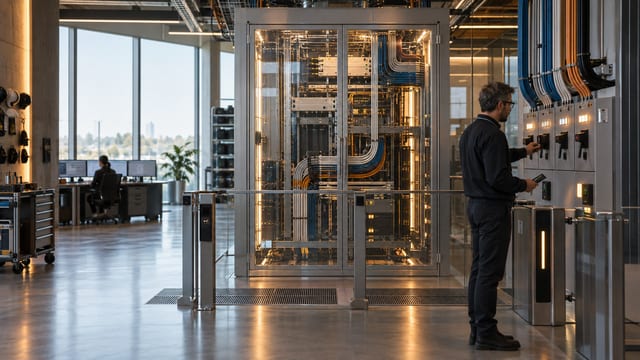
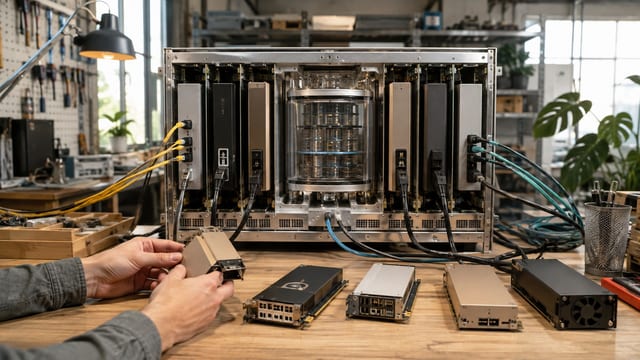
The final piece is infrastructure. Mistral announced the Les Ulis site in Essonne, France — a new 10 MW facility dedicated to inference, scheduled to open in Q3 2026. The reasoning is supply-chain control: owning capacity directly, the company argues, provides "greater security and transparency as training and inference hardware converge."
It's a small footprint next to the gigawatt-scale buildouts from US hyperscalers. But it fits the thesis. If you're promising aerospace and chip firms that their data never leaves trusted hands, owning the silicon it runs on is the logical endpoint.
The timing is also commercial. As training and inference hardware converge and GPU supply stays tight, a lab that controls even a slice of its own capacity can promise enterprise customers predictable latency and uptime — guarantees that matter far more to a manufacturer than they do to a casual chatbot user.
What this signals
Mistral is reading a gap in the market. The frontier-model race — bigger context, higher benchmarks, cheaper tokens — is brutally crowded and increasingly commoditized. Industrial AI grounded in physics and bound by data sovereignty is a narrower, stickier, and far more defensible business, especially in Europe.
The risk is execution. Crash simulation and lithography optimization are not demos you can fake; they either produce trustworthy numbers or they don't. Airbus, BMW, and ASML are exactly the kind of customers who will quietly walk away if the physics doesn't hold up.
The Bottom Line
Mistral is no longer trying to win the chatbot war. With the Emmi acquisition, marquee deals at Airbus, BMW, and ASML, and its own inference data center, it is repositioning as the AI layer for European heavy industry — selling capability and control. If physics AI delivers on real engineering problems, this pivot could prove far more durable than another point on a benchmark chart.