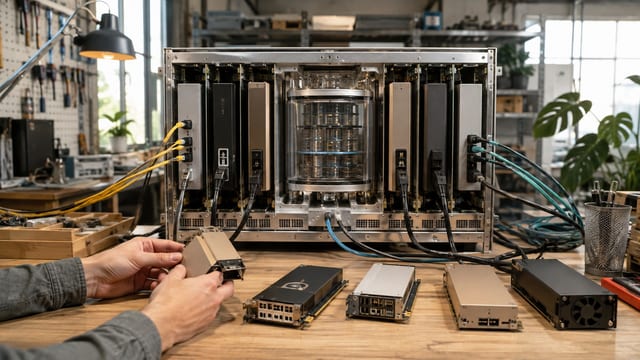
On July 21, 2026, Poolside did something the Western open-weight scene has been waiting on for a year: it shipped a coding model good enough to argue with the frontier, and gave the weights away. Laguna S 2.1 is a 118-billion-parameter Mixture-of-Experts model built for agentic coding, released on Hugging Face under a permissive license. It is not a research toy. It is a working coder that, on Poolside's own numbers, beats open models several times its size.
Here is why that matters, and where the asterisks are.
What Poolside actually released
Laguna S 2.1 is a sparse MoE: 118B total parameters, but only about 8B activate per token. That is the whole trick. You get the knowledge capacity of a large model with the inference cost of a small one. The routing layer picks a handful of specialist "experts" for each token instead of firing every parameter on every word.
The architecture is unusually specific for an open release:
| Spec | Laguna S 2.1 |
|---|---|
| Total parameters | 118B |
| Active per token | ~8B |
| Experts | 256 routed (top-10) + 1 shared |
| Layers | 48 (12 global : 36 sliding-window attention) |
| Context window | 1,048,576 tokens |
| License | OpenMDW-1.1 |
That 1-to-3 ratio of global to sliding-window attention is a deliberate cost play. Full global attention over a million tokens is brutally expensive, so most layers only look at a local window. It keeps the long-context bill sane without throwing away the occasional model-wide view.
Two weeks earlier, on July 2, Poolside also dropped Laguna XS 2.1 — a 33B MoE small enough to run on a single GPU, shipped with DFlash speculator models for faster decoding. The XS-then-S cadence is the same playbook the frontier labs use: seed the ecosystem with the cheap one, then land the flagship.
The benchmarks — and the honest caveat
Poolside's published table is genuinely strong. On its own evaluations, Laguna S 2.1 scores:
- 78.5% on SWE-Bench Multilingual — topping the published table outright
- 70.2% on Terminal-Bench 2.1
- 59.4% on SWE-Bench Pro
- 40.4% on DeepSWE
The SWE-Bench Multilingual number is the headline. Beating every model in your comparison table on a multilingual coding benchmark is a real result — if the table holds up under independent testing.
And that is the caveat worth stating plainly: these are first-party benchmarks. Every lab picks the evaluation suite that flatters it most, and "beats rivals 10x its size" is exactly the phrase a launch post is engineered to produce. The architecture is legitimate and the weights are downloadable, so independent reproduction is possible — but until third parties confirm the numbers, treat the leaderboard claim as a hypothesis, not a fact.
Why the license is the real story
The spec sheet will get the headlines. The license is what actually changes anyone's week.
Laguna S 2.1 ships under OpenMDW-1.1, which permits free commercial and non-commercial use and modification. Poolside didn't just post the raw weights, either — it published FP8, NVFP4, and INT4 quantized variants plus GGUF conversions on day one. That is the difference between a model you admire and a model you run. A team with a couple of consumer GPUs can pull the GGUF build and have an agentic coder answering to their own repo by the afternoon, with no per-token API meter running.
For Western enterprises that have spent 2026 nervously eyeing Chinese open-weight coders like Kimi and GLM, this is the domestic option they kept saying they wanted. "The West's most capable open-weight model" is a marketing line, but it points at a real anxiety: until now, the strongest downloadable coders were mostly coming out of Beijing and Hangzhou.
Where it fits
Laguna S 2.1 is not trying to be your general chatbot. It is a specialist — an agentic coding engine you wire into an IDE, a CI pipeline, or an autonomous dev loop, where the 1M-token window lets it hold an entire service in context while it refactors. The 8B active footprint means self-hosting is plausible for mid-sized shops, not just hyperscalers.
The competition it walks into is fierce. Frontier proprietary coders keep raising the bar, and the open-weight field is crowded with capable MoEs. Laguna's pitch is narrow and sharp: frontier-adjacent coding, permissively licensed, quantized and ready to self-host. That is a defensible lane.
The Bottom Line
Laguna S 2.1 is the most credible Western open-weight coding model to land in 2026, and Poolside deserves credit for shipping the quantized builds and a genuinely permissive license on day one rather than dribbling them out later. The 118B/8B-active MoE design is exactly the shape a self-hostable agentic coder should be. Just hold the "beats models 10x its size" banner loosely until independent benchmarks catch up — first-party leaderboards have a way of shrinking under scrutiny. If you run your own inference and you have been waiting for an open coder you can actually deploy without a data-sovereignty argument, download it and test it on your own repo this week.