OpenClaw is the fastest-growing repo in GitHub history — and the most chaotic launch of 2026
Six months ago OpenClaw did not exist. Today the project sits at 371,000 stars and 76,000 forks on GitHub, has carried three different names in a 72-hour stretch, survived a trademark dispute with Anthropic, lost its X handle to crypto scammers in a ten-second window, and pulled its founder into a senior role at OpenAI. The repository was created on November 24, 2025.
That is roughly 60,000 stars per month — a pace that overtook React's all-time count in March 2026 and made OpenClaw, briefly, the most-starred software repository in GitHub history. The project is also useful, which is the part most coverage gets wrong.
What it actually is
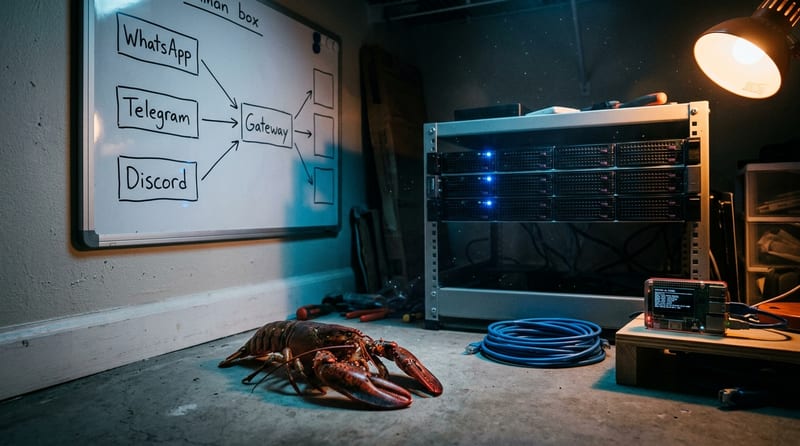
OpenClaw bills itself as "your own personal AI assistant. Any OS. Any platform. The lobster way." In engineering terms it is a self-hosted gateway written in TypeScript that connects an LLM of your choice to the messaging apps you already use. The gateway runs on your machine or VPS, holds your credentials locally, and routes natural-language messages to a model — Claude, GPT, Gemini, DeepSeek, or any OpenAI-compatible endpoint — then executes tool calls on your behalf.
It is MIT-licensed. The default branch is main. Minimum runtime is Node.js 22.
The connector list is the differentiator. Out of the box, OpenClaw speaks:
- WhatsApp, Telegram, Signal, iMessage, Discord, Slack, Microsoft Teams
- Google Chat, Matrix, IRC, Feishu, LINE, Mattermost
- Nextcloud Talk, Nostr, Synology Chat, Tlon, Twitch, Zalo, WeChat, QQ
- A built-in WebChat for when you want a local UI
You text your assistant on WhatsApp, it runs in a Docker container on a 4GB VPS, and the conversation never touches a third-party agent provider. That is the entire pitch.
Why it actually grew
The launch curve is not a fluke. Three things converged:
1. Self-hosting hit a nerve. Every major AI assistant in 2025 — ChatGPT, Claude, Gemini — added "personal assistant" features that required handing the vendor your inbox, your calendar, and your message history. OpenClaw is the same product without the data hand-over. For users in regulated industries, in Europe under GDPR, and in countries that don't trust U.S. cloud providers, that is the difference between using AI and being banned from using AI.
2. The connector matrix is genuinely hard to replicate. Most personal-AI projects ship with one or two channels. OpenClaw ships with 20+ working out of the box, each maintained as a plugin. The community has been adding more — the awesome-openclaw list grows weekly.
3. The founder narrative is compulsively watchable. Peter Steinberger, an Austrian developer best known for his iOS work at PSPDFKit, started shipping releases roughly every two days through the winter. The pace, the lobster mascot, and a string of viral demos kept the repo trending continuously on GitHub through Q1 2026.
The three names and what they cost
Clawdbot → Moltbot → OpenClaw, in 72 hours.
The original name Clawdbot triggered a polite but firm trademark request from Anthropic — phonetic overlap with Claude, plus a lobster mascot named "Clawd." Steinberger agreed to rename. On January 27, 2026, the project became Moltbot, keeping the crustacean theme. Three days later, on January 30, 2026, he renamed it again to OpenClaw, citing that "Moltbot" never quite rolled off the tongue.
The cost of that second rename was real money. To claim the moltbot handle on X, you have to release the old one. To claim openclaw, same thing. The release-and-reclaim window for the X handle was roughly ten seconds. Crypto scammers, who had been watching, grabbed both abandoned handles instantly, set up shop, and announced a CLAWD token.
The fake token hit a $16 million market cap before Steinberger could post a denial. When he did — "I will never do a coin. Any project that lists me as coin owner is a SCAM" — it dropped to under $800,000 within minutes. The Discord followed up with a blanket ban on any mention of crypto or Bitcoin, a policy that itself became a small-scale community controversy.
The Cline supply chain attack
The other notable scar happened on February 17, 2026. An attacker exploited a prompt-injection vulnerability in Cline CLI's Claude-powered issue triage workflow and compromised an npm publish token. They pushed Cline CLI 2.3.0 with a malicious postinstall script:
"postinstall": "npm install -g openclaw@latest"
For roughly eight hours, anyone installing or updating Cline CLI got OpenClaw silently installed system-wide. Cline shipped 2.4.0 to mitigate, deprecated 2.3.0, and moved the npm publishing pipeline to OIDC-via-GitHub-Actions.
The attack was not really about OpenClaw — OpenClaw was the payload because OpenClaw was the hottest repo of the quarter, and shoving it onto thousands of developer machines was the joke. It was still a wake-up call. By March, a copycat NPM package — @openclaw-ai/openclawai — appeared with a real malicious payload (the GhostLoader RAT). The official package lives under the bare name openclaw and the org openclaw. Anything else is a fake.
Getting it running
The Docker path is the supported one:
git clone https://github.com/openclaw/openclaw
cd openclaw
./scripts/docker/setup.sh
docker compose up -d
Minimum host requirements: 2 GB RAM for the image build (pnpm install will OOM-kill on 1 GB), and Docker Compose v2. Recommended deployment is a 2-vCPU VPS with 4 GB RAM for always-on use.
Configuration and workspace data are bind-mounted to /home/node/.openclaw and /home/node/.openclaw/workspace, so container replacement is non-destructive. Pre-built images live at ghcr.io/openclaw/openclaw:latest if you'd rather not build locally.
The model layer is fully swappable. Drop in an OpenRouter key and you have access to Claude, GPT, Gemini, Kimi K2.6, DeepSeek, or any local Ollama endpoint. Kimi K2.6 in particular is a strong default for the always-on agent loop — Moonshot explicitly named OpenClaw as a target use case at K2.6 launch.
The OpenAI plot twist
In February 2026, OpenAI hired Steinberger to lead its personal-AI-agents division under Sam Altman. OpenClaw remained open-source. OpenAI provides infrastructure and resources; the codebase is still on GitHub under the same MIT license; releases continue. The arrangement reads less like an acquihire and more like a strategic patronage — OpenAI wants the personal-agent narrative, and the fastest-growing personal-agent repo in history is now nominally in its column.
The community is split on whether that is a good thing. The repo still ships, the connectors still work, and the project has not been moved or relicensed. But the question — what happens to a self-hosting-first project when its founder works for a hyperscaler? — is one the next year will answer.
The Bottom Line
OpenClaw is the rare 2026 repo where the star count is justified by the code. The connector matrix, the self-hosting story, and the pluggable model layer are all genuinely useful — and the rapid-release cadence has kept feature gaps closing instead of opening. The drama around it — the triple rebrand, the $16M phantom token, the Cline supply chain incident, the OpenAI move — would have killed a lesser project five times over.
It didn't. If you want a personal AI agent that lives on your VPS, talks to WhatsApp, runs whichever model you trust, and never phones home to a SaaS dashboard, this is the one to install. Just make sure the package name is openclaw and the org is openclaw. Everything else is somebody else's joke.