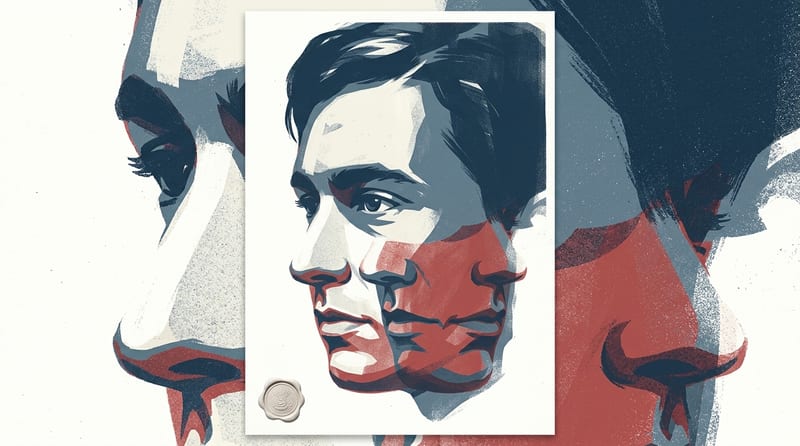
What if your face were a copyrighted work — and you were its author? That is, almost literally, the question Denmark has put to Europe. In the summer of 2025, the Danish government announced it would fight AI deepfakes by amending its Copyright Act to give every person control over reproductions of their own appearance and voice. The amendments are expected to take effect in July 2026, and they have turned a small Nordic country into the unlikely center of a global argument about who owns a human likeness.
It is one of the most creative legal responses to deepfakes yet proposed. It may also be built on the wrong foundation. Both of those things can be true at once.
What Denmark is actually proposing
The Danish bill, notified to the European Commission and analyzed by the European Parliamentary Research Service (EPRS), has two parts: a general protection against realistic, digitally generated imitations of a person's personal characteristics, and a specific protection for performers against imitations of their work.
The mechanics are straightforward in principle. Making such an imitation publicly available would require the consent of the person being imitated. The protection would last for 50 years after that person's death — the same posthumous term logic copyright applies to creative works. Crucially, it covers everyone, not just celebrities and public figures. The schoolteacher targeted by a fabricated video has the same standing as a pop star.
There are deliberate carve-outs. Expressions of caricature, satire, parody, and pastiche are, in principle, excluded — an attempt to keep political commentary and comedy out of the takedown machinery.
How enforcement would actually work
A right is only as good as the takedown it enables, and this is where the design gets clever. Denmark does not propose building a new enforcement bureaucracy. Instead, it leans on the EU's Digital Services Act (DSA) and its Article 16 notice-and-action mechanism — the same pipeline platforms already use to handle illegal content.
By defining a non-consensual deepfake as copyright-infringing content under Danish law, the bill gives victims a concrete, legally recognized basis to file a DSA notice. That matters, because the people who already work on this problem say the current system fails ordinary users.
"The key issue we've had in enforcing our members' right to voice, image, etc., is the lack of recognition of personality rights as a basis for removing content from online platforms such as Meta and TikTok," said Thomas Heldrup of the Danish Rights Alliance. Routing the harm through copyright, advocates argue, gives takedown requests teeth that pure personality-rights claims have historically lacked.
In other words, the appeal is not legal theory. It is the practical reality that artists have long had more luck getting infringing material removed than private citizens do. Denmark is trying to extend that leverage to everyone.
The objection: this isn't really copyright
Here is the uncomfortable part, and the EPRS brief does not hide it: the Danish rules are not copyright in the strict sense, and Denmark's own authorities admit it.
Copyright protects original works that reflect, in the words of the Court of Justice of the EU, the "author's own intellectual creation." A face is not authored. As the EPRS analysis notes, intangible personal characteristics like voice and image, considered in isolation, do not naturally fall under copyright at all. Worse, copyright in a photograph traditionally belongs to the photographer, not the person depicted — so on classic doctrine, the subject of a deepfake would not even be the rights-holder of the source material.
In the explanatory notes to the draft, Danish authorities concede they do not intend to create a genuine new copyright for citizens. They are using the Copyright Act as a convenient vehicle to codify unwritten personality-rights principles — borrowing copyright's enforcement plumbing without its philosophical basis.
Why the framing choice has teeth
This is not pedantry. The legal container you choose changes what the right is.
Copyright is an economic instrument. It is designed to be transferred, licensed, and sold. Personality rights — the right to your own image, voice, and dignity — are generally treated as inalienable: they cannot be signed away wholesale because they are bound to the person, not to a balance sheet. Critics warn that pouring identity into a copyright mold risks turning faces and voices into commodified, sellable assets — the very outcome that should worry anyone watching AI-avatar marketplaces emerge.
The risk is not hypothetical. People have already sold their likeness for avatar creation and then watched it appear in ads they never approved. A framework built to make likeness tradeable could accelerate exactly that, even as it tries to protect against abuse.
The case for doing it anyway
Defenders of the Danish approach make a pragmatic argument that deserves a fair hearing. Yes, personality rights are the "purer" framework — but they have failed in practice to get content removed from major platforms, while copyright claims succeed. If the goal is protecting real victims today rather than winning a doctrinal debate, using the tool platforms already respect is defensible. Legal certainty for a harassed teenager arguably matters more than taxonomic tidiness.
There is also genuine momentum. A declaration agreed under the Danish EU Council Presidency, endorsing protection against non-consensual digital replicas, was signed by every EU member state except Hungary, plus five other European countries. Ireland has signaled it intends to follow Denmark's model. And in spring 2026, the European Parliament took up an own-initiative report on copyright and generative AI. Denmark has, at minimum, forced the question onto the agenda.
What this means beyond Denmark
The hard limits are worth stating plainly. Because the rules are national, Danish protection would mostly bite through geo-blocking by very large platforms and search engines — meaning a deepfake blocked in Denmark could remain visible everywhere else unless other countries follow. A patchwork of national likeness-copyright regimes is not a solution to a borderless problem; it is a starting gun.
Skeptics also note that Denmark already has tools — its Criminal Code, the Marketing Practices Act, the GDPR, the AI Act, and the EU directive on violence against women all touch deepfake harms. Some experts argue the marginal value lies less in inventing a new right than in enforcing the ones that already exist.
The Bottom Line
Denmark's deepfake law is the right instinct reaching for a flawed tool. Giving ordinary people a real, enforceable hook to pull non-consensual imitations offline is overdue, and routing it through the DSA's existing machinery is genuinely smart. But by dressing personality rights in copyright's clothes, Denmark risks making identity itself a tradeable commodity — and by acting nationally, it can only geo-fence a global harm. The likely legacy of Denmark's experiment is not the statute itself, but the pressure it puts on the EU to build a coherent, borderless answer to a question that is not going away: in the age of generative AI, who owns your face?