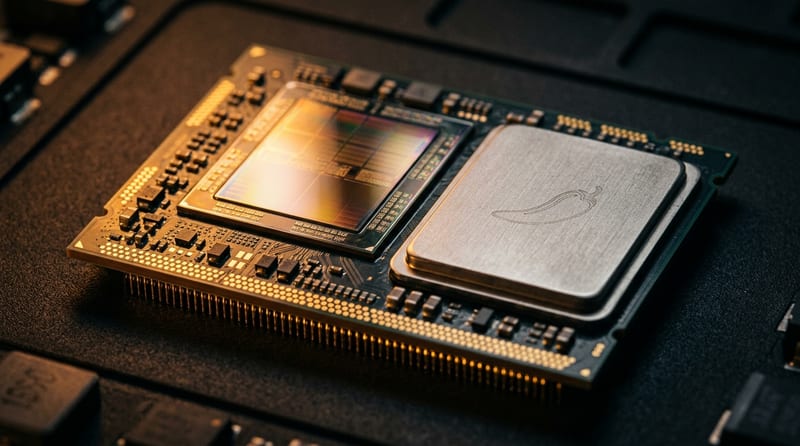
OpenAI has built a chip. After years of paying Nvidia's margins, the company behind ChatGPT unveiled Jalapeño on June 24, 2026 — its first custom silicon, co-designed with Broadcom and manufactured on TSMC's 3nm process. It is not a training chip, and that is the whole point.
Jalapeño is built for inference: the work of actually running a trained model when a user types a prompt. That is where OpenAI spends the overwhelming majority of its compute budget today, and where a purpose-built accelerator can pay for itself fastest.
What OpenAI actually announced
OpenAI is calling Jalapeño an "Intelligence Processor" — the first accelerator in what it describes as a multi-generation compute platform being built jointly with Broadcom. Broadcom supplies the networking, packaging, and physical design expertise; OpenAI contributed the architecture, shaped around its own view of how large language models will be served at scale.
The headline engineering claim is speed of execution. OpenAI says Jalapeño went from initial design to manufacturing tape-out in roughly nine months — a pace it and Broadcom characterize as among the fastest ever for a high-performance ASIC. Notably, OpenAI says its own models helped accelerate parts of the chip's development.
This is a big piece of silicon. The compute die measures roughly 25.46 mm × 33 mm, putting it around 840 mm² — right up against the ~858 mm² reticle limit of current EUV lithography. In plain terms: this is about as large as a single chip can physically be made today.
The economics: cutting the Nvidia tax
The strategic logic is straightforward. OpenAI's largest recurring cost is inference, and today that cost flows largely to Nvidia. Jalapeño is aimed at cutting inference compute cost by roughly half compared with current Nvidia GPUs, while delivering performance in the neighborhood of Nvidia's Blackwell generation and, OpenAI claims, substantially better performance per watt.
A custom inference chip does not need to beat Nvidia at everything. It needs to run OpenAI's models, on OpenAI's infrastructure, cheaper. That is a far easier target — and a far more valuable one.
Perf-per-watt matters more than raw speed at hyperscale. When you are deploying at gigawatt scale, the power bill and the cooling constraints often decide how much intelligence you can actually ship. A chip that does the same work for less energy directly expands capacity.
Who gets it, and when
Deployment is slated to begin in late 2026, ramping through 2027 and reaching full volume in the first half of 2028, according to Broadcom's leadership. The chips are earmarked for gigawatt-scale data centers operated by OpenAI and its partners.
The most telling detail is a customer: Microsoft is reported to have committed to roughly 40% of the initial production run for Azure. That signals confidence from OpenAI's closest infrastructure partner and suggests Jalapeño is intended to serve workloads well beyond OpenAI's own products.
| Detail | Jalapeño |
|---|---|
| Announced | June 24, 2026 |
| Partner | Broadcom |
| Foundry / node | TSMC, 3nm |
| Purpose | LLM inference |
| Die size | ~840 mm² (near reticle limit) |
| Design-to-tape-out | ~9 months |
| Cost target | ~50% lower per token vs. current Nvidia GPUs |
| First deployment | Late 2026 |
Why this is bigger than one chip
Every major AI lab is now trying to escape its dependence on a single supplier. Google has TPUs, Amazon has Trainium and Inferentia, and Anthropic leans heavily on Google and Amazon silicon. OpenAI was the conspicuous exception — buying Nvidia at scale while its rivals diversified. Jalapeño ends that.
It also reframes OpenAI as an infrastructure company, not just a model lab. Owning the accelerator, the software stack, and the model creates a vertical loop competitors will find hard to match on cost. If the ~50% figure holds up in production, the pressure lands squarely on Nvidia's inference margins — the most lucrative and, until now, least contested part of its business.
The caveats are real. These are pre-deployment numbers from the companies selling the chip, tape-out is not mass production, and "late 2026" targets in semiconductors have a way of slipping. Jalapeño still has to prove itself against Blackwell in a live data center, not a slide.
The Bottom Line
Jalapeño is OpenAI's declaration that it intends to own its own economics. It will not replace Nvidia overnight, and the impressive numbers are still vendor claims awaiting real-world validation. But the direction is unmistakable: the company that defined the modern AI boom no longer wants to rent the hardware that runs it. If the chip lands on schedule and on budget, the inference market — the part of AI that actually makes money — gets a lot more competitive in 2027.