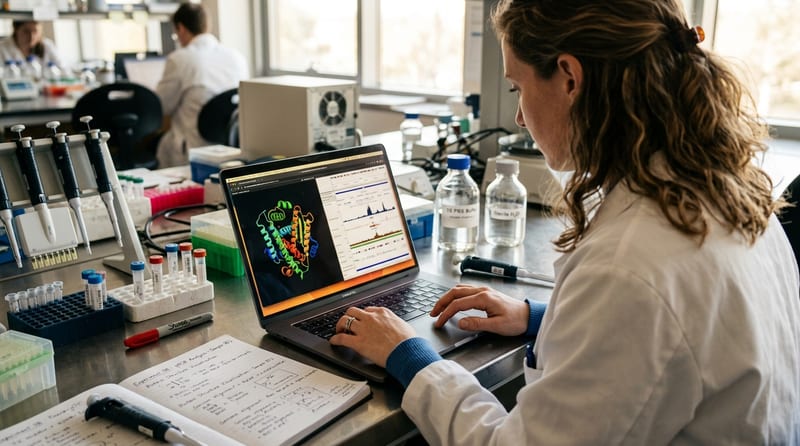
Anthropic just moved its life-sciences ambitions out of the lab and onto every researcher's laptop. On June 30, 2026, the company launched Claude Science, an AI workbench built specifically for scientific work, in beta for Pro, Max, Team, and Enterprise subscribers. It runs on macOS and Linux, and it is a deliberate departure from the generic chat window.
The pitch is simple and, if it holds up, quietly radical: instead of a chatbot that happens to know biology, Claude Science is a research environment that unifies the fragmented tooling scientists already juggle every day.
The problem it targets
Anyone who has done computational science knows the tax. A single project might mean querying PubMed, wrangling data in Jupyter, running R scripts, and pushing jobs to a cluster terminal, with each database carrying its own schema and each file format demanding a bespoke pipeline. The actual thinking gets buried under plumbing.
Claude Science collapses that stack into one place. Users talk to a generalist coordinating agent with access to over 60 curated skills and connectors pre-configured for genomics, single-cell analysis, proteomics, structural biology, and cheminformatics. That agent can spin up sub-agents and hand off to specialist agents users build themselves.
Three features that matter
Reproducible artifacts. When Claude Science generates a figure, it ships the exact code and environment that produced it, a plain-language description of the method, and the full message history. You can tell it "change that axis to log scale" or "remove the gridlines" in plain English, and it edits its own code. Every output traces back to how it was made, which is the whole game in science.
Compute that scales on demand. Large analyses like folding a protein or running a genomics pipeline usually mean babysitting a job queue. Claude Science drafts a plan, asks before touching new resources, and submits work to whatever infrastructure your lab already uses, whether that is your own HPC cluster over SSH or a Modal account for on-demand GPUs. Because sessions hold context in memory, even massive datasets load only once, and sensitive data never has to leave the systems it already lives on.
A reviewer agent. As a pipeline runs, a dedicated reviewer agent inspects outputs, flagging incorrect citations, untraceable numbers, and figures that do not match their underlying code, then self-corrects. It is an actor-critic loop applied to research, and it directly attacks the trust problem that has kept many scientists skeptical of AI-generated results.
The workbench is domain-ready on arrival. Ask a plain-language question and specialist agents query and synthesize across resources like UniProt, PDB, Ensembl, Reactome, ClinVar, ChEMBL, and GEO. It also plugs into NVIDIA's BioNeMo Agent Toolkit, connecting natively to models including Evo 2, Boltz-2, and OpenFold3.
Does it actually work?
Anthropic points to three early users, and the numbers are the interesting part.
Neuroscientist Jérôme Lecoq of the Allen Institute built a multi-agent "computational review template" of roughly 20 custom skills. Work that once took his team as long as two years now yields around 10 reviews, many over 100 pages, with citations checked by reviewer agents.
At the UCSF Brain Tumor Center, epidemiologist Stephen Francis used it for germline analysis on glioma and reported comprehensive workups in roughly one-tenth of the time previously required, with his group independently validating the results. Drug-discovery startup Manifold Bio used Claude Science to nominate targets for tissue-targeting medicines, assessing surface expression, trafficking, and safety end to end.
| Researcher | Institution | Reported impact |
|---|---|---|
| Jérôme Lecoq | Allen Institute | ~2 years down to ~10 long-form reviews |
| Stephen Francis | UCSF Brain Tumor Center | ~10x faster germline analysis |
| Manifold Bio | Biotech | End-to-end target nomination |
Anecdotes are not benchmarks, and every case here was validated by the humans running it. But the pattern, faster iteration with a machine checking the machine, is the right one to watch.
Grants and access
Anthropic is backing the launch with money as well as software. It will support up to 50 AI for Science projects with up to $30,000 in credits each, and Modal is adding up to $2,000 in compute for select projects. The focus is on work that spans domains, with an early tilt toward biology and biomedical research.
If you want in, the timeline is tight. Applications close July 15, 2026, award notifications go out by July 31, and funded projects run from September 1 to December 1, 2026. There is also a discounted Team plan for academic labs and nonprofit research organizations.
The Bottom Line
Claude Science is Anthropic's bet that the bottleneck in AI-assisted research is not raw model intelligence but workflow, the friction of moving between tools, formats, and clusters. By wrapping a coordinating agent, reproducible artifacts, on-demand compute, and a built-in reviewer into one environment, it addresses the exact complaints scientists have voiced about generic chatbots. It is beta software, the impressive results are self-reported, and reproducibility claims deserve independent scrutiny. But as a statement of direction, it is the most serious attempt yet to make an AI a working member of the lab rather than a novelty on the side.