Google has a habit of quietly releasing experimental tools that reshape entire workflows. Stitch 2.0 is one of them — and it just topped Product Hunt's March 2026 leaderboard with over 820 upvotes.
What Is Google Stitch?
Stitch is a free AI-powered design tool from Google Labs that converts natural language descriptions into production-ready UI designs and frontend code. Originally launched at Google I/O in May 2025, the tool was born from Google's acquisition of Galileo AI, a startup that specialized in prompt-to-UI generation. The Galileo team joined Google and rebranded their product as Stitch under the Google Labs umbrella.
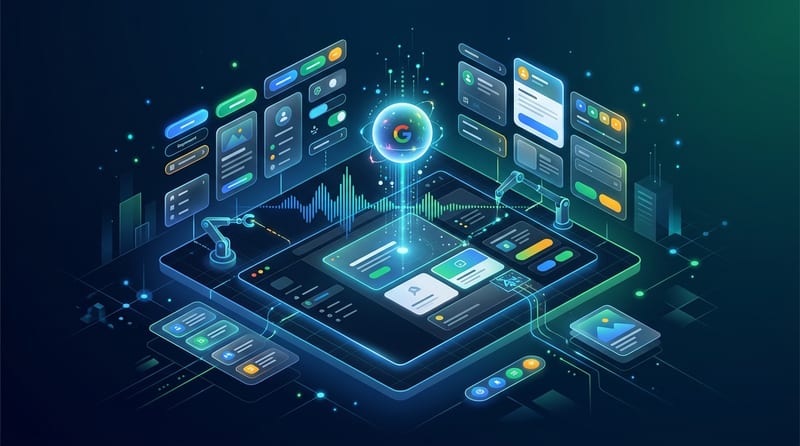
The March 2026 update — Stitch 2.0 — is a significant leap. It replaces the original single-turn prompt workflow with an AI-native infinite canvas, a persistent workspace where designers and non-designers alike can iterate, collaborate, and build complete interactive flows.
The Key Features
Vibe Design is the headline addition. Instead of writing precise prompts like "create a login form with email and password fields," you describe intent. Tell Stitch what you want users to feel when they land on a page, cite a business objective, or paste a link to something inspiring. The AI interprets the mood and generates UI to match.
Voice Canvas takes this further. Introduced with the March 2026 update, it lets you speak to Stitch like a collaborator. The AI agent doesn't just execute commands — it interviews you about your design goals, critiques what's already on the canvas, suggests alternatives, and makes real-time updates as you talk. It's closer to pair-designing with a junior designer than issuing commands to a tool.
Interactive Prototypes solve the "now what?" problem. Stitch transforms static mockups into clickable prototypes instantly. You can "stitch" screens together and hit Play to preview your app flow — no need to export to Figma or InVision first.
DESIGN.md is a smart addition for teams. It's an agent-friendly markdown file that captures your design system rules. You can extract a design system from any URL, or import/export rules to keep your AI-generated designs consistent with your brand. It also bridges Stitch with other design and coding tools through native MCP (Model Context Protocol) export.
For solo founders and PMs who can't afford to spend a week on mockups, Stitch 2.0 effectively eliminates the prototyping bottleneck.
Under the Hood
Stitch 2.0 runs on multiple Gemini models. Standard mode uses Gemini 2.5 Flash for fast generation, while Pro mode leverages Gemini 2.5 Pro for complex layouts, image-to-UI conversion, and higher-fidelity output. Recent updates have also integrated Gemini 3 capabilities for improved contextual understanding and accessibility in generated interfaces.
This multimodal foundation gives Stitch the ability to process sketches, screenshots, wireframes, and photos — converting any visual input into editable digital interfaces. The tool exports clean frontend code and supports pasting designs directly into Figma for team collaboration.
What It Costs
Stitch 2.0 is free at stitch.withgoogle.com — no subscription or credit card required. However, there are monthly usage limits: roughly 350 generations per month in Standard mode (Gemini 2.5 Flash) and around 50–100 generations per month in Pro/Experimental mode (Gemini 2.5 Pro).
For most individual users and small teams, the free tier is more than sufficient. Google hasn't announced paid plans yet, keeping this firmly in the "free experiment" category for now.
Who Should Pay Attention
Stitch 2.0 is most valuable for founders, product managers, and developers who need to move from idea to interactive prototype fast. If you're a solo builder who skips the design phase because Figma feels like overhead, Stitch just removed that excuse.
For professional designers, the tool is more of a rapid ideation assistant than a Figma replacement. The generated UI is good enough for user testing and stakeholder buy-in, but you'll still want to refine in your primary design tool for production.
The Bottom Line
Google Stitch 2.0 turns "describe what you want" into a real design workflow — complete with voice collaboration, vibe-based generation, and instant prototypes. It's free, it's fast, and it's backed by Google's best multimodal models. For anyone who's ever stalled at the mockup stage, this is the tool that gets you past it.