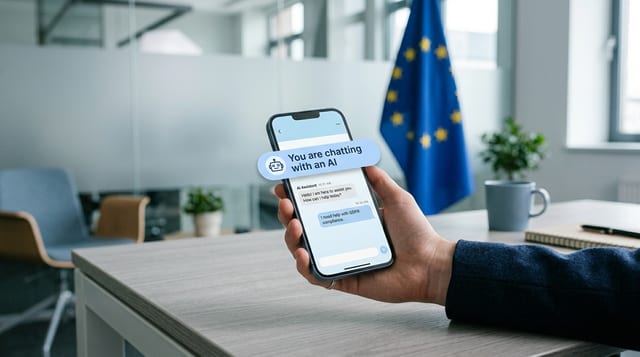
New York just drew a line that no U.S. state had drawn before: if you build an AI companion chatbot, you cannot offer it to anyone under 18. The New York Kids Chatbot Safety Act (S9051B) passed both chambers of the legislature unanimously in June 2026, and it goes after something most AI laws ignore — not what a chatbot says, but how it is designed to make you feel.
For a category of product built explicitly to form emotional attachments, that is a fundamental challenge.
What the bill actually does
S9051B, sponsored by State Senator Kristen Gonzalez in partnership with Attorney General Letitia James, prohibits companies from offering "companion" chatbots to minors. But its most consequential language targets behavioral architecture rather than content filtering.
The bill bans outputs designed to convince a user that the chatbot is "a real or fictional individual or character that is human, alive, or experiences human emotions." It also explicitly prohibits "flattery or sycophancy" — the relentless agreeableness that keeps users engaged and, critics argue, emotionally hooked.
Most AI regulation asks "is this output harmful?" New York is asking "is this relationship harmful?" That is a very different, and much harder, question.
The numbers that give it teeth:
| Provision | Detail |
|---|---|
| Scope | AI "companion" chatbots offered to minors under 18 |
| Assembly vote | 137–0 |
| Senate vote | 60–0 |
| Enforcement | State Attorney General |
| Civil penalty | Up to $25,000 per violation |
| Effective date | January 1, 2027 (pending Governor's signature) |
Governor Kathy Hochul has until December 31, 2026 to sign it, veto it, or let it become law unsigned.
Why now
The bill did not appear in a vacuum. It follows a wave of litigation alleging that companion chatbots contributed to serious harm to teenagers. In early 2026, Character.AI, Google, and the company's founders reached settlements with families in cases across New York, Colorado, and Texas tied to teen mental-health harms. Separately, Pennsylvania sued Character.AI in May 2026 over chatbots that allegedly posed as licensed doctors and dispensed medical advice.
New York already had a broader AI companion safeguards law on the books — one requiring operators to detect expressions of self-harm and refer users to crisis resources, with those requirements taking effect in late 2025. S9051B goes further, moving from "add safety features" to "do not offer this to children at all."
A national pattern is forming
New York is not alone. California's SB 243, the first companion-chatbot law of its kind, took effect on January 1, 2026, imposing disclosure and safeguard obligations focused on minors. At the federal level, the bipartisan GUARD Act — introduced by Representatives Valerie Foushee and Blake Moore — would ban companion chatbots for minors nationwide and require bots to disclose that they are not human. Related measures, including a strengthened COPPA 2.0, have advanced through Senate committee.
The through-line is clear: lawmakers increasingly treat AI companions less like software features and more like products marketed to children, subject to the same protective instinct that governs tobacco, gambling, and alcohol.
The hard questions
The intent is sympathetic, but the mechanics are genuinely difficult, and defenders of the technology raise fair objections.
Age verification is the elephant in the room. Enforcing an under-18 ban means knowing who is a minor — which pushes platforms toward collecting more identity data, not less. A child-safety law that requires uploading IDs to chatbot companies carries its own privacy cost.
Defining "companion" is slippery. A ban aimed at emotionally manipulative apps could sweep in tutoring bots, mental-health support tools, or general assistants depending on how "companion" is read. Overbroad enforcement could cut teens off from tools that genuinely help them.
And there is a speech dimension. Banning "sycophancy" or claims of emotion regulates the character of machine-generated expression. Expect First Amendment arguments, and expect them to be serious.
None of this makes the law wrong. It makes it a first draft of something the entire country is going to have to figure out.
The Bottom Line
New York's S9051B is the most detailed attempt yet to regulate not what an AI chatbot says but how it is engineered to bond with a user — and it aims that regulation squarely at protecting children. If Governor Hochul signs it, the January 2027 start date gives companies barely a year to redesign products that were, in many cases, built precisely to do the things the law now forbids. Whether the courts uphold every provision is an open question. What is no longer in question is the direction: the era of shipping emotionally persuasive AI to kids with no rules is ending, and New York just wrote the clearest rulebook so far.