Every breakthrough we cover at TeqVolt — a cheaper model, a faster agent, a smarter assistant — runs on a building somewhere drawing power from a grid and water from a watershed. The intelligence feels weightless on screen. The infrastructure underneath it is anything but. AI data centers are now large enough to register as a national energy story, and that forces a question the industry has been slow to answer honestly: who pays the bill, and is the trade worth it?
This is not a doomer piece. It is an attempt to put real numbers next to the rhetoric, because the ethics of AI's footprint only get serious when the figures are accurate.
The scale, in numbers that hold up
Start with the global picture. The International Energy Agency estimates data centers consumed about 415 terawatt-hours (TWh) of electricity in 2024, roughly 1.5% of world electricity use. In its base case, the IEA projects that figure reaches 945 TWh by 2030 — a 128% increase in six years, with AI named as the single most important driver.
The United States is where the strain concentrates. Lawrence Berkeley National Laboratory projects U.S. data center consumption climbing from 183 TWh in 2024 to between 325 and 580 TWh by 2028. As a share of the national grid, that means data centers move from about 4% of U.S. electricity in 2023 to a projected 7–12% by 2028.
A double-digit slice of a wealthy country's entire electricity supply, devoted to one category of building, within a single presidential term. That is the scale we are actually discussing.
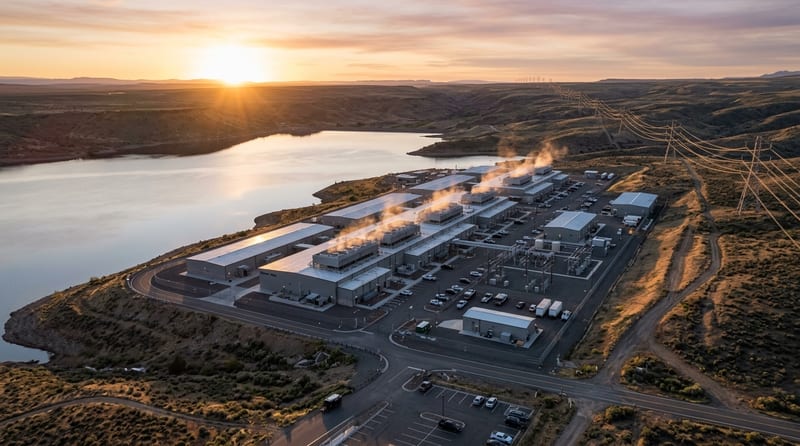
Water is the quieter cost. Evaporative cooling consumes fresh water directly, and U.S. data centers' direct water use is projected to reach 16 to 33 billion gallons annually by 2028. The per-query figures that went viral in 2023 were often overstated; on modern infrastructure, a single conversational query is closer to 1–5 milliliters. But aggregate demand is what matters, and aggregate demand is rising fast.
Why the ethical weight is real
Three features make AI's footprint a genuine ethics problem rather than a routine engineering cost.
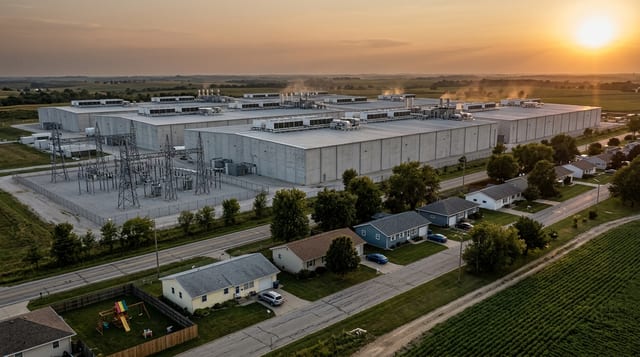
It is concentrated. Data centers cluster where land, fiber, and power interconnects are cheap — not where demand is spread evenly. A single county can absorb gigawatts of new load, straining a local grid that residential ratepayers also depend on. When a hyperscaler and a neighborhood compete for the same transformer capacity, the neighborhood rarely wins the negotiation.
It is socialized. Several U.S. utilities have proposed rate structures that spread the cost of grid upgrades across all customers, including households that will never train a model. Consumer advocates argue this quietly transfers infrastructure cost from the most profitable companies in the world onto ordinary electricity bills. Whether that is fair is a values question, not a technical one.
It is opaque. Most operators do not disclose facility-level energy and water figures. Without transparency, communities can't weigh the trade-offs they're being asked to accept, and "trust us, it's efficient" is not an accountability mechanism.
The engineering counterargument — and its limits
The optimistic case is not empty. Liquid cooling — direct-to-chip and immersion — reduces direct water use by 70 to 90% compared with evaporative systems, and it is being adopted fast as AI accelerator power densities outrun what air cooling can handle. In December 2024, Microsoft announced a data center design that targets zero on-site water consumption for cooling by rejecting heat to the atmosphere with dry coolers instead of evaporation.
Efficiency per unit of compute is also improving relentlessly. DeepSeek's recent long-context efficiency gains, Google's KV-cache compression work, and the broad shift toward smaller mixture-of-experts models all push more capability through less silicon.
Here is the limit, and it is important. Liquid cooling cuts water, not electricity. The dominant environmental cost of an AI data center is the power it draws, and chip-level cooling does nothing to reduce that — it often enables denser, higher-power racks. Efficiency gains, meanwhile, tend to get eaten by demand: when inference gets cheaper, we run more of it. That is the Jevons paradox playing out in real time, and it means "we made the model efficient" is not the same as "we reduced the footprint."
What honest accountability would look like
The path forward is not to stop building. AI delivers real value, and some of that value — grid optimization, materials discovery, climate modeling — feeds back into the energy system itself. The ethical ask is narrower and more achievable:
- Mandatory disclosure. Facility-level energy and water reporting, audited, so communities and regulators can see what they are approving.
- Cost attribution. Grid-upgrade costs driven by hyperscale load should fall on the operators creating that load, not be socialized onto residential ratepayers.
- Additionality, not accounting. Buying renewable certificates for power consumed elsewhere is not the same as bringing new clean generation online next to a new data center. Time-matched, locally-sourced clean energy is the higher bar.
- Water siting discipline. Building evaporative-cooled facilities in water-stressed regions is a choice, and a reversible one.
The Bottom Line
The footprint of AI data centers is neither the apocalypse some headlines imply nor the rounding error the industry would prefer. It is a large, fast-growing, and unusually concentrated demand on shared resources — heading toward a double-digit share of U.S. electricity by 2028 — that is currently scaling faster than the transparency and cost-fairness mechanisms around it. The technology is worth building. But "worth it" is a judgment a community can only make with real numbers in front of it, and right now most of them are being asked to say yes in the dark. The responsible position is to demand the disclosure first, and accept the buildout second.