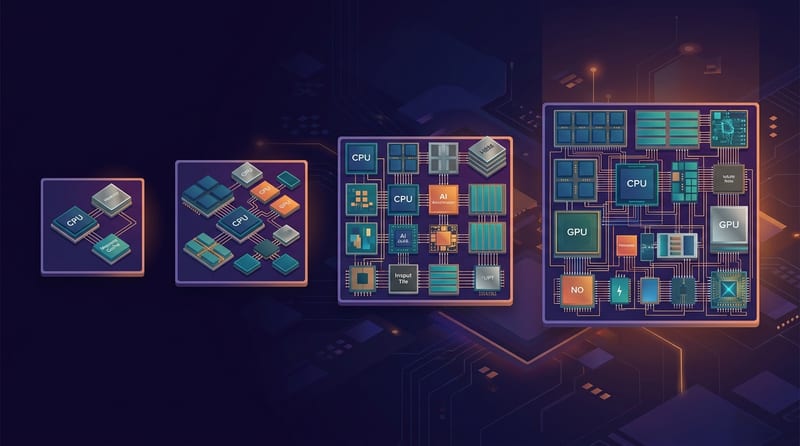
Meta just declared silicon independence. In March 2026, the company unveiled four generations of custom MTIA chips — the MTIA 300, 400, 450, and 500 — in a move that fundamentally reshapes the AI hardware landscape. While the rest of the industry waits in line for Nvidia's next GPU, Meta is building its own silicon at a pace that would make most chipmakers uncomfortable: a new chip generation every six months.
The Strategic Bet: Why Meta Is Building Its Own Chips
Meta runs AI at a scale that few companies can match. Every Instagram recommendation, every Facebook feed ranking, every WhatsApp suggested reply — these all run on AI inference hardware. At that scale, even small efficiency gains translate to massive cost savings.
The MTIA (Meta Training and Inference Accelerator) program isn't about replacing Nvidia entirely. Meta still signed major GPU deals in early 2026. Instead, it's about owning the optimization stack for workloads Meta understands better than anyone: ranking, recommendations, and increasingly, generative AI inference for billions of users.
Four Chips, One Modular Architecture
All four MTIA chips share a common foundation built on the open-source RISC-V instruction set, manufactured by TSMC, and co-developed with Broadcom. The modular chiplet design is the key innovation — it allows Meta to swap compute, network, and memory chiplets independently, manufacturing each at its optimal process node.
MTIA 300: The Production Workhorse
The MTIA 300 is already deployed in Meta's data centers, handling ranking and recommendation training workloads. Its architecture features one compute chiplet paired with two network chiplets and multiple HBM stacks.
Each Processing Element (PE) contains two RISC-V vector cores, a Dot Product Engine, Special Function Unit, Reduction Engine, and DMA engine. Built-in NIC chiplets with dedicated message engines enable high-bandwidth chip-to-chip communication without relying on external network cards.
MTIA 400: Doubling Down on Compute
The MTIA 400 doubles the compute density with two compute chiplets and delivers some serious gains over its predecessor:
- 400% higher FP8 FLOPS compared to MTIA 300
- 51% higher HBM bandwidth
- Enhanced MX8 and MX4 data type support
- Scale-up domain of 72 devices per rack via switched backplane
Meta states that raw performance is competitive with leading commercial products — a pointed reference to Nvidia without naming names. The MTIA 400 has completed lab testing and is planned for data center deployment in 2026.
MTIA 450: Built for GenAI Inference
This is where things get interesting for the generative AI era. The MTIA 450 is specifically optimized for GenAI inference with:
- Doubled HBM bandwidth compared to MTIA 400
- 75% increase in MX4 FLOPS
- Hardware acceleration for attention and feed-forward network operations
- Low-precision data types delivering 6x MX4 FLOPS versus FP16/BF16
The attention/FFN hardware acceleration is significant — these are the computational bottlenecks in transformer inference. By building dedicated silicon for them, Meta can extract efficiency that general-purpose GPUs can't match for these specific workloads. Mass deployment is scheduled for early 2027.
MTIA 500: The Peak of the Roadmap
The MTIA 500 pushes the envelope further with a 2x2 compute chiplet configuration plus a dedicated SoC chiplet for PCIe and scale-out NICs:
- 50% higher HBM bandwidth than MTIA 450
- Up to 80% more HBM capacity
- 43% higher MX4 FLOPS than MTIA 450
Across the full MTIA 300-to-500 progression, Meta claims 4.5x growth in HBM bandwidth and a 25x increase in compute FLOPS (tracking the MX8-to-MX4 progression). Mass production is scheduled for 2027.
The Software Story: PyTorch-Native by Design
Hardware means nothing without software, and Meta has a significant advantage here: PyTorch. The MTIA software stack is built natively on PyTorch and leverages industry-standard tools including vLLM for inference serving, Triton for kernel development, and OCP (Open Compute Project) standards for hardware interfaces.
This means engineers already building on PyTorch don't need to learn a new framework or rewrite their inference pipelines. It's a deliberate contrast to Nvidia's CUDA ecosystem — Meta is betting on open standards rather than proprietary lock-in.
What This Means for the AI Chip Market
Meta's six-month release cadence is unprecedented in the semiconductor industry, where chip generations typically arrive every 12–24 months. The modular chiplet approach makes this possible by allowing incremental improvements without full redesigns.
The implications extend beyond Meta's own data centers. By building on RISC-V and OCP standards, Meta is creating a reference architecture that other hyperscalers and enterprises could potentially adopt. And by reducing its dependence on Nvidia for inference workloads, Meta gains both cost leverage and supply chain resilience.
The Bottom Line
Meta's MTIA program is the most ambitious custom silicon effort in the AI industry right now. Four chip generations in roughly two years, a 25x compute improvement from MTIA 300 to 500, and a software stack built on open standards rather than proprietary lock-in. Whether this actually dents Nvidia's dominance remains to be seen, but Meta is clearly building the infrastructure to run AI at billion-user scale on its own terms.