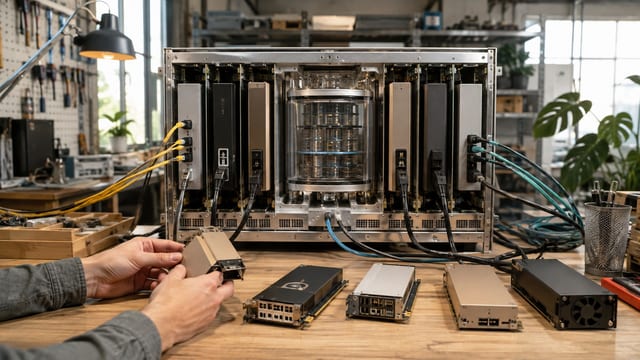
Big Pharma just made its boldest AI play yet. Eli Lilly has launched LillyPod, the most powerful AI supercomputer wholly owned by a pharmaceutical company — and it is built to fundamentally reshape how medicines are discovered, tested, and manufactured.
What Is LillyPod?
LillyPod is an NVIDIA DGX SuperPOD built on DGX B300 systems, packed with 1,016 NVIDIA Blackwell Ultra GPUs. It delivers over 9,000 petaflops of AI performance — that is 9 quintillion math operations per second. To put that in perspective, a single Blackwell Ultra GPU packs roughly the equivalent computing power of 7 million 1992-era Cray supercomputers.
The system was announced at NVIDIA GTC in October 2025 and went live in February 2026, assembled in just four months. It is managed using NVIDIA Mission Control software for orchestrating all 1,000+ GPUs simultaneously.
Why Pharma Needs a Supercomputer
Drug development is brutally slow and expensive. A typical new drug takes 10 to 15 years to go from initial discovery to a patient's hands, and the average cost exceeds $2 billion. A productive wet-lab team can test roughly 2,000 molecular hypotheses per target per year. LillyPod changes those economics by letting scientists explore billions of molecular possibilities in parallel.
"Foundation models are spawning new possibilities for chemists, helping uncover new atomic configurations previously unreachable." — Thomas Fuchs, Chief AI Officer, Eli Lilly
The system is not just raw compute — it is integrated with Lilly TuneLab, the company's internal drug discovery platform that offers both proprietary Lilly models and NVIDIA Clara open foundation models. It also uses NVIDIA FLARE for federated learning, enabling privacy-preserving collaboration across research teams.
What LillyPod Actually Does
Lilly is deploying LillyPod across the full drug development pipeline:
- Genomics and Biomarker Discovery — analyzing genome sequences and predicting patient outcomes at scale
- Molecular Design — generating and testing new antibodies, nanobodies, and novel molecules
- Clinical Trial Optimization — using large language models to design better trials and accelerate decision-making
- Imaging-Based Precision Medicine — reducing medical image processing times from months to days
- Manufacturing Digital Twins — optimizing production with simulation, robotic quality inspection, and supply chain management
The Bigger Picture
LillyPod is part of Lilly's broader U.S. manufacturing and R&D expansion, which the company says will exceed $50 billion in total investment since 2020. That includes a proposed $4.5 billion Lilly Medicine Foundry facility in Indiana and four new manufacturing sites expected to create more than 3,000 high-skilled jobs and nearly 10,000 construction jobs.
Lilly has also expanded its relationship with Insilico Medicine in a deal worth up to $2.75 billion, announced March 29, 2026, gaining an exclusive worldwide license to develop and commercialize preclinical assets discovered through AI-driven research. And a separate $1 billion co-innovation lab with NVIDIA in South San Francisco, announced in January 2026, signals this is not a one-off investment — it is a strategic pivot.
What This Means for the Industry
LillyPod is not the first pharma supercomputer, but it is the first at this scale under single-company ownership. The message to competitors is clear: AI infrastructure is now a core competitive asset in drug discovery, not an IT side project.
Lilly aims for its AI supercomputing infrastructure to run on 100% renewable electricity by 2030, using efficient liquid cooling with minimal incremental energy impact.
The Bottom Line
Eli Lilly is treating AI compute the way it treats its molecule pipeline — as a strategic investment that compounds over time. With 9,000 petaflops of dedicated AI power, the question is not whether AI-driven drug discovery will become the norm, but how quickly Lilly's competitors will follow suit.