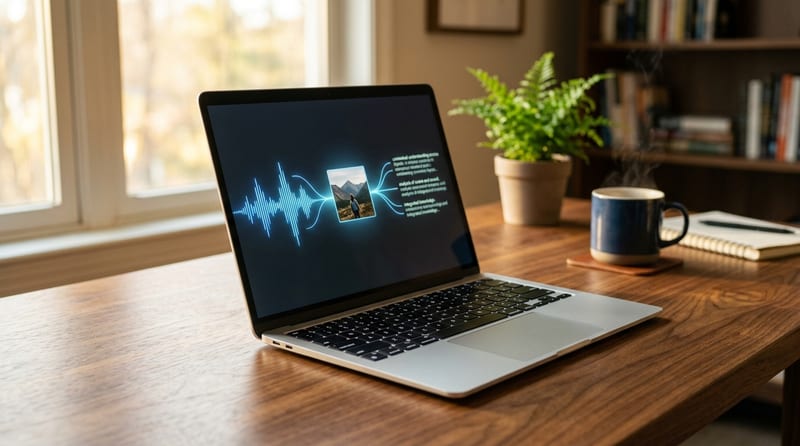
Google has spent the better part of two years arguing that open models do not have to be big to be good. Gemma 4 12B, released on June 3, 2026, is the most pointed version of that argument yet: a multimodal model that ingests text, images, and audio, runs on a laptop with 16GB of memory, and throws out the encoder stack that nearly every other vision-language model still leans on.
It slots neatly into the lineup Google shipped in April. The edge-class E2B and E4B handle phones and IoT. The 26B Mixture-of-Experts and 31B Dense target workstations. Gemma 4 12B fills the gap in the middle — and it is the first mid-sized Gemma to accept native audio input.
The encoder-free bet
Here is the genuinely interesting part. Most multimodal models bolt a separate encoder onto the language model: a vision tower converts pixels into embeddings, an audio tower does the same for sound, and only then does the LLM see anything. Those encoders work, but they cost latency and memory.
Google trained Gemma 4 12B without them.
"Because these split encoders add latency and increase memory usage, we trained Gemma 4 12B with an encoder-free architecture to integrate audio and vision input directly." — Google DeepMind
For vision, Google replaced the encoder with a lightweight embedding module — a single matrix multiplication, positional embedding, and normalizations — and let the LLM backbone do the visual processing itself. For audio, the team went further and removed the encoder entirely, projecting the raw audio signal straight into the same dimensional space as text tokens.
The practical payoff is a model that handles three modalities through one unified transformer instead of three stitched-together subsystems. Fewer moving parts, less memory, lower latency.
Performance per gigabyte
Gemma 4 12B is built to sit just below the 26B MoE on quality while using less than half the total memory footprint, according to Google. On standard benchmarks its scores approach the larger model's, which is the entire pitch: near-26B reasoning that fits in a 16GB laptop.
To keep responses snappy, the model ships with Multi-Token Prediction (MTP) drafters, a speculative-decoding technique that drafts several tokens ahead to cut latency. Combined with the encoder-free design, that makes it viable for genuinely local agentic work — not just chat, but tool-calling and multi-step tasks running entirely on your machine.
| Spec | Gemma 4 12B |
|---|---|
| Modalities | Text, image, audio (input) |
| Local memory | Runs on 16GB RAM / VRAM |
| Architecture | Encoder-free unified transformer |
| Latency feature | Multi-Token Prediction drafters |
| License | Apache 2.0 |
Why "open" still matters here
Gemma 4 12B ships under a commercially permissive Apache 2.0 license — no monthly-active-user caps, no usage gates. That is the same license as the rest of the Gemma 4 family, and it is a deliberate contrast to the bespoke community licenses some rivals attach to their open weights.
The momentum behind that decision is real. Google says the Gemma 4 family has now crossed 150 million downloads, with developers building everything from wearable robotic arms to enterprise security tooling on top of it. An open license that lets you run a capable multimodal model offline, on hardware you already own, is the kind of thing that compounds.
Google also used the launch to release an official Gemma Skills Repository on GitHub — a library of skills aimed at helping agents build with Gemma models, a nod to how much of the ecosystem is now agent-shaped.
Getting it running
The model landed with broad day-one support, so there is no waiting on the toolchain to catch up. You can try it in a couple of clicks through LM Studio, Ollama, the Google AI Edge Gallery app, or the LiteRT-LM CLI. Weights — both pre-trained and instruction-tuned — are on Hugging Face and Kaggle.
For building, Gemma 4 12B works with Hugging Face Transformers, llama.cpp, MLX, SGLang, and vLLM, and fine-tunes through Unsloth. For production, Google points to Cloud Run, GKE, and its Model Garden. In other words: pick whatever you already use.
The Bottom Line
Gemma 4 12B is not chasing a leaderboard crown. It is chasing a different prize — the best multimodal reasoning you can run on the laptop already on your desk. By dropping the encoder stack, accepting audio natively, and staying under a 16GB memory ceiling, it makes a strong case that the most useful model is often the one you can run yourself, offline, for free. For developers who care about cost, privacy, and digital sovereignty, that is a more compelling story than another half-point on a benchmark. The encoder-free experiment is the part worth watching: if it holds up, expect the rest of the industry to follow Google out of the encoder business.